Creative Strategy
Creative Strategy
Google App Campaign Management That Scales
Google app campaign management connects creative, measurement, and bidding to drive lower-cost installs, trials, and purchases without losing control.
Google app campaign management can look deceptively simple: set a goal, add assets, choose a budget, and let automation find users. Then installs rise while trial quality drops. Or CPI looks efficient while revenue stalls. The issue is rarely that Google needs more freedom. It is that the campaign has been given weak signals, generic creative, or an optimization event that does not reflect real business value.
App campaigns are built to automate distribution across Google inventory. That makes them powerful at scale and unforgiving when the inputs are vague. Growth teams that treat them as a hands-off install channel usually get exactly what they asked for: volume without enough control over the kind of customer being acquired.
What Google App Campaign Management Actually Owns
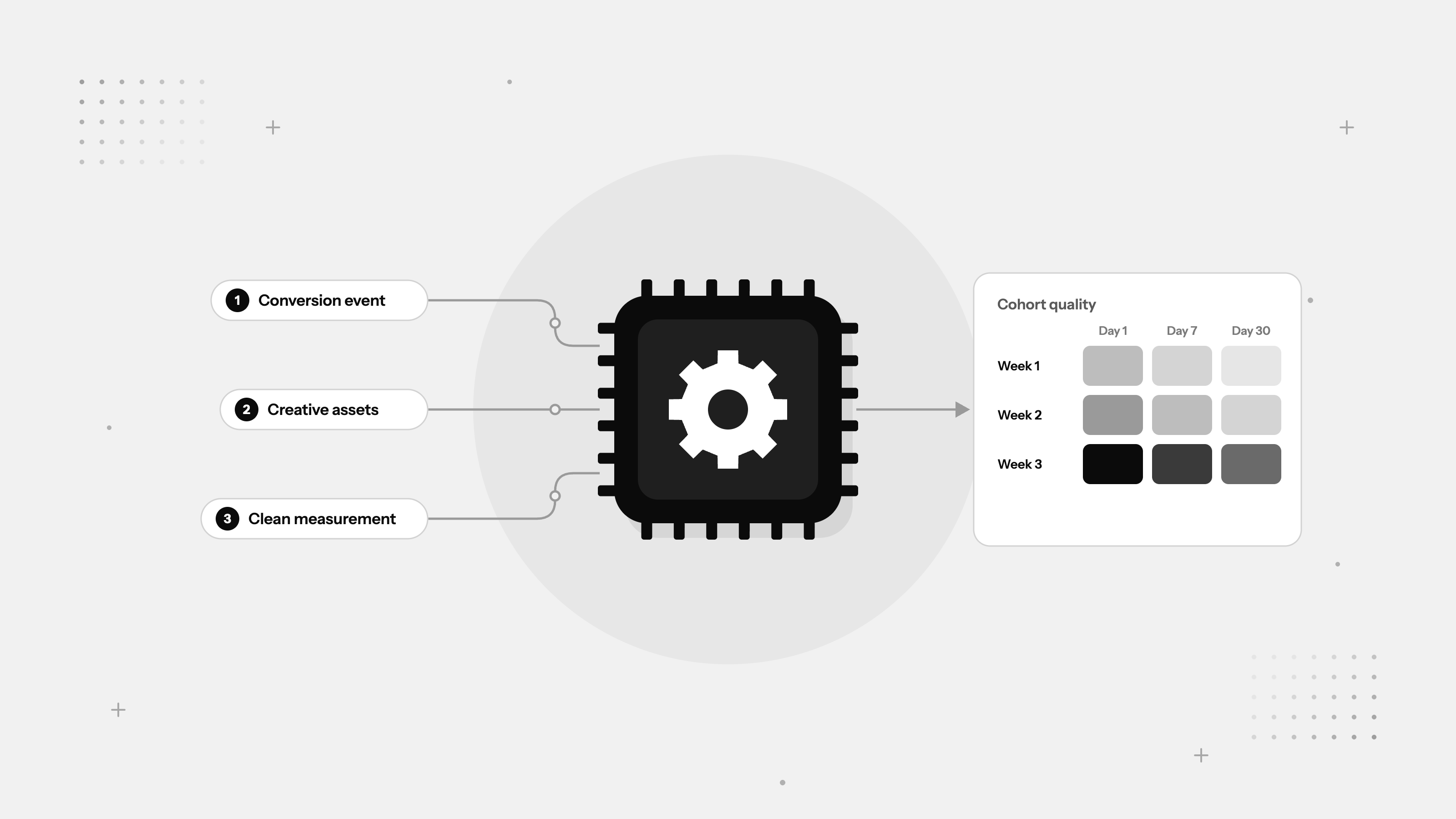
Effective management is not daily bid tinkering. Most bid and placement decisions sit inside Google's automation. The work is upstream and ongoing: defining the right conversion event, protecting measurement integrity, creating platform-ready assets, managing budget and target changes carefully, and reading performance through cohort quality rather than dashboard vanity metrics.
For a mobile game, the right objective may be users who complete a tutorial and reach a meaningful gameplay milestone, not simply first opens. For a subscription app, it may be a trial that survives past onboarding or a first paid renewal. For a commerce app, it may be a first purchase with enough margin to support acquisition costs.
The difference matters because Google will pursue the event you feed it. If the event is easy to generate but poorly correlated with revenue, the algorithm will find more low-intent users at impressive speed.
Start with the conversion event, not the campaign settings
A clean event hierarchy keeps automation pointed toward commercial outcomes. Install data can be useful for a new app with limited volume, but it should be a bridge, not a permanent strategy. As volume grows, move toward qualified in-app actions and value-based optimization.
That transition depends on enough reliable conversion data. Asking a campaign to optimize for paid subscriptions when it sees only a few each week can create unstable delivery. In that case, optimize first toward a high-intent proxy, such as completing a personalized plan, finishing an account setup, or starting a trial. Validate that the proxy predicts downstream revenue before committing spend.
For iOS apps, privacy constraints add another layer. Your MMP setup, SKAdNetwork postbacks, modeled conversions, and event mapping need to tell a consistent story. For Android, Firebase or MMP event quality still matters. A broken parameter, duplicated purchase event, or misconfigured revenue value can make a smart bidding system aggressively optimize toward bad data.
Creative Is the Main Lever Google Can Use
App campaigns do not give media buyers the placement-by-placement levers they may expect from Meta or TikTok. Creative carries more of the targeting burden. Every video, image, text line, and playable format teaches the system who may respond and gives it material to distribute across different environments.
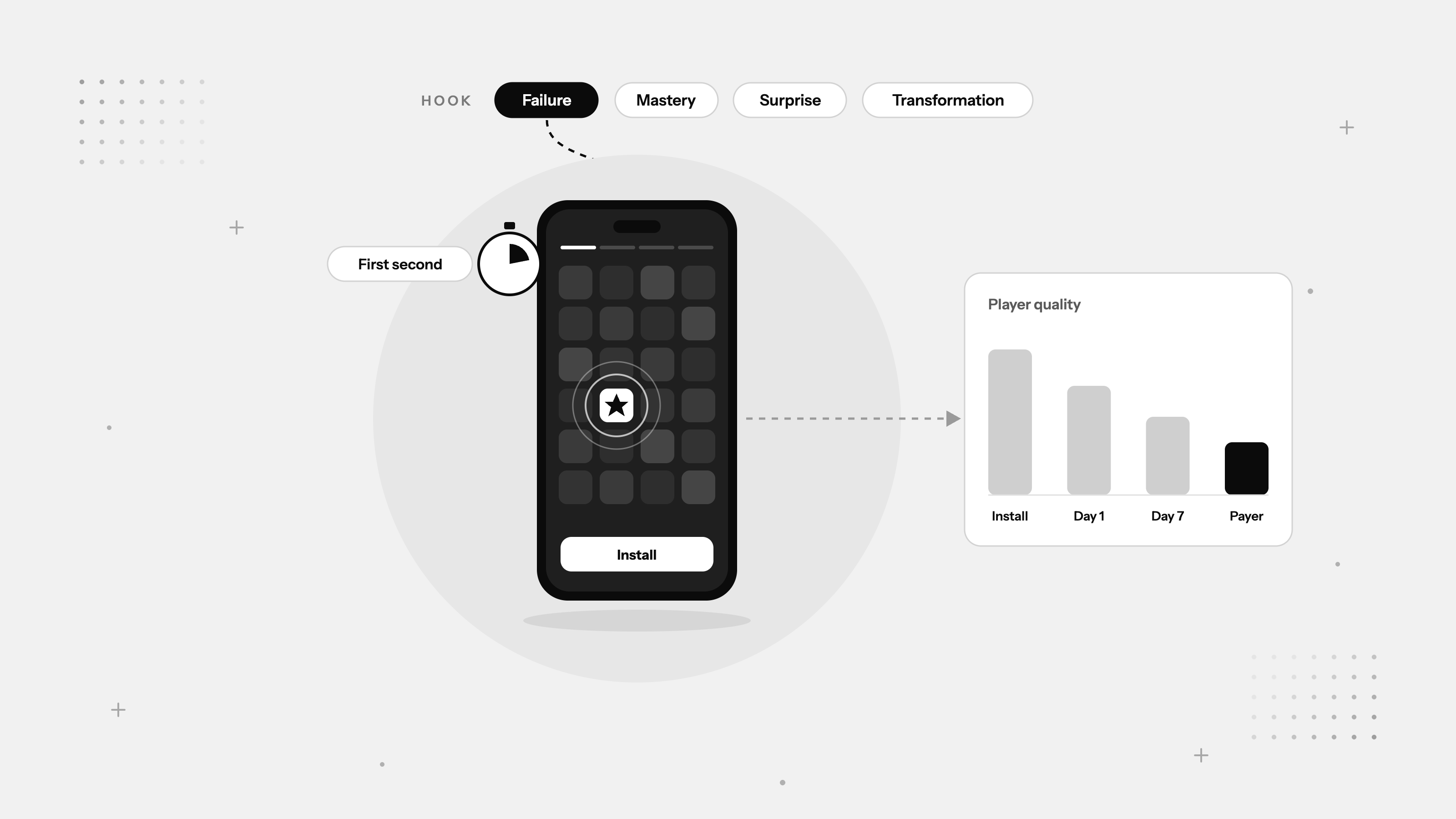
That is why a single polished brand video is not an app campaign creative strategy. It may look good on a landing page and still fail to communicate the product in the first two seconds. Performance assets need a job: qualify the audience, demonstrate the product, create urgency, or resolve an objection before the click.
For games, gameplay should do the selling. Show the core loop, the tension, the upgrade, and the payoff. If the ad promises an experience the app cannot deliver, cheap installs become expensive churn. For wellness and subscription products, lead with the problem moment and the outcome users can actually reach. A creator explaining why they abandoned a complicated routine for a 10-minute plan can outperform a polished feature montage because it makes the use case immediately legible.
Build creative around testable hypotheses
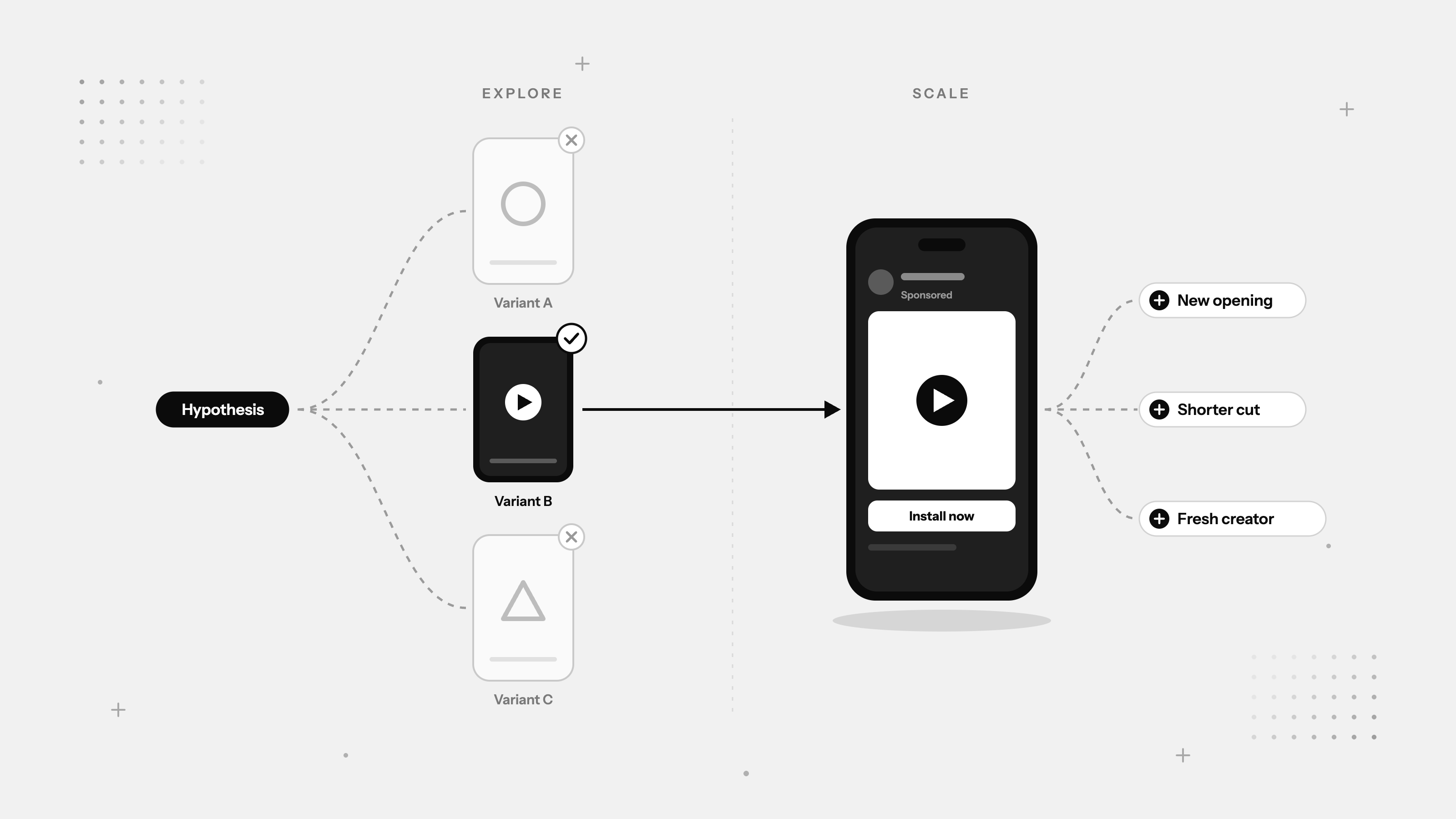
Stop testing ads. Start testing hooks.
A useful creative testing system separates the idea from the execution. One concept might test whether users respond better to saving time, reducing stress, competing with friends, or getting a visible result. Within that concept, create variations in opening frame, spokesperson, pacing, proof point, and call to action. This lets the team learn why performance moved instead of merely labeling one asset a winner.
Assets should be produced in multiple orientations and lengths, with clear visual hierarchy and no dependency on sound. A strong vertical creator video may need a separate treatment for landscape or a shorter, more direct edit for inventory where attention disappears quickly. Google can adapt assets, but it cannot invent a compelling first frame or turn vague benefits into a sharp message.
Refresh cadence depends on spend, audience size, and creative fatigue. High-spend accounts may need meaningful new concepts every week. Smaller accounts may need fewer releases, but each should be deliberate. Recutting the same footage with a new caption is not a creative pipeline.
Structure Campaigns Around Different Jobs
Over-segmenting app campaigns can starve them of data. Under-segmenting them can hide meaningful differences in geography, platform, language, or business objective. The right structure is usually simple enough to preserve learning and distinct enough to protect strategic decisions.
Separate Android and iOS because their measurement, inventory behavior, and economics differ. Separate markets when localization or LTV differs materially. A US subscription app should not allow lower-value international volume to make its blended CPA look healthier than it is. If a brand has a clear reactivation objective, it should also be evaluated separately from new user acquisition.
Creative themes can justify separate campaigns when they represent genuinely different audiences or product angles. A kids gaming platform might have one theme focused on parent trust and another on gameplay excitement. A fitness app might distinguish beginner confidence from advanced performance. Do not split campaigns simply because the creative files are different. Split when the message, audience signal, or optimization goal is meaningfully different.
Budget changes deserve discipline. Large increases can reset learning and make weekly results difficult to interpret. Scale in measured steps, watch conversion volume and marginal CPA, then decide whether additional spend is finding incremental qualified users or just buying more expensive ones. The best campaign is not the one with the biggest install chart. It is the one that can spend more while holding the economics that matter.
Read Performance Beyond CPI
CPI is a cost metric, not a growth strategy. It can help diagnose creative appeal and market competition, but it cannot tell you whether acquired users are valuable.
Google app campaign management should be judged against the full path from impression to retained customer. Review install-to-registration rate, activation, trial starts, purchase conversion, retention, revenue per install, and payback period. For games, add level progression, ad engagement, in-app purchase behavior, and payer rate. The precise dashboard differs by business model, but every team needs a shared definition of a qualified user.
Cohort analysis is where many apparent wins fall apart. A campaign may generate an excellent week-one CPA while producing lower day-30 retention than another campaign with a slightly higher cost. When that happens, the answer is not automatically to cut the higher-CPI campaign. It may be bringing in a more valuable user. The real comparison is cost against predicted or realized lifetime value.
Diagnose the constraint before changing the target
When performance deteriorates, teams often lower a target CPA or tighten a return-on-ad-spend goal immediately. That may reduce spend without solving the actual problem. First identify the constraint.
If click-through rate and store conversion have dropped, creative or store listing relevance may be weakening. If installs hold but activation falls, the ad message may be overpromising or onboarding may be failing. If activation is stable but trial-to-paid conversion declines, look at pricing, payment flow, or the quality of the event used for optimization. If every metric weakens at once, check attribution and event tracking before making media decisions.
Automation does not eliminate the need for judgment. It increases the cost of unclear strategy.
Treat Store Conversion as Part of Media Performance
The ad creates intent. The store listing either carries that intent forward or wastes it. Screenshots, preview video, ratings, reviews, onboarding expectations, and the first screen after install all affect the economics of an app campaign.
Message matching is especially important. If an ad promises daily meal plans, the store page should not lead with a generic meditation feature. If gameplay creative highlights a specific puzzle mechanic, show that mechanic clearly in the listing. Users should feel they arrived where the ad said they would arrive.
This is also where creative and product teams need to work like one growth function. Paid media can identify the promise that earns attention. Product and store optimization can make sure that promise survives the install and becomes a retained customer.
Google's automation is not a substitute for a growth team. It is a force multiplier for one. Feed it clean signals, give it ads built around real audience insight, and measure the customer quality that keeps the business growing. That is how app campaigns become a scalable acquisition engine instead of a black box with a budget.