Influencer Marketing
Influencer Marketing
How to Source Performance Creators That Scale
Learn how to source performance creators who can produce platform-native ads, generate clean testing signals, and lower CPA across paid social campaigns.

A creator who looks polished on Instagram can still fail completely in a Meta or TikTok acquisition campaign. The difference is not follower count, lighting, or whether they call themselves a UGC creator. If you want to know how to source performance creators, start with the only qualification that matters: can this person make an ad that earns attention, communicates a claim clearly, and gives your media team a usable testing variable?
Performance creator sourcing is not influencer casting. It is a production and measurement problem. You are building a repeatable bench of people who can deliver assets that run in live campaigns, not buying one-off reach from people with attractive feeds.
Define What “Performance” Means for Your Funnel
Before outreach begins, define the job the creator needs to do. A creator for a mobile game may need to capture authentic gameplay reactions, explain a mechanic in the first three seconds, and sell the progression loop. A creator for a wellness subscription may need to make a compliant, believable problem-solution story that moves a cold audience toward a trial.
Those are different briefs, different casting criteria, and often different creator profiles. Treating every creator as interchangeable is how brands end up with 20 versions of the same soft testimonial and no insight into what actually drove conversion.
Start with your performance data. Review your strongest ads by thumb-stop rate, hold rate, click-through rate, cost per acquisition, trial rate, purchase rate, and payback where applicable. Then separate what worked into components: the opening hook, talent type, setting, angle, proof device, pacing, offer framing, and call to action.
Your creator brief should answer a few practical questions in plain language. Who must the creator feel credible to? What objection should the script overcome? Is the asset intended to test a new concept or scale a proven one? What visual behavior is required on camera? A creator who can convincingly demonstrate an app in a real-world setting is more valuable than someone who can simply read a script with energy.
How to Source Performance Creators Beyond Follower Count
The best creator pool usually comes from several sources, not one marketplace. Creator platforms can accelerate volume, but they often optimize discovery around audience size, category labels, or aesthetic style. That is useful for top-of-funnel influencer work. It is less useful when you need direct-response assets at speed.
Build sourcing across creator databases, specialist casting partners, outbound prospecting on TikTok and Instagram, referrals from proven talent, and customer or employee communities where appropriate. The goal is not maximum choice. It is a qualified pipeline with enough depth to match different angles, demographics, and production needs.
When reviewing candidates, look for evidence that they understand paid creative. Strong signals include direct-to-camera clarity, natural product demonstration, comfort with multiple hook variations, clean audio, reliable framing, and a willingness to follow a structured brief without sounding scripted. Ask to see raw examples alongside final edits. A beautiful portfolio can hide weak delivery, extensive post-production, or footage that gives editors very little flexibility.
Do not over-index on polished production. Native, believable footage frequently beats content that feels like a traditional commercial, especially on TikTok and Reels. But native does not mean careless. The creator still needs to deliver usable footage with clear product visibility, enough coverage for editing, and no avoidable compliance or brand-safety issues.
A small creator with a strong conversion instinct can outperform a larger personality whose content is built for entertainment. For paid acquisition, you are licensing a performance capability, not renting an audience.
Score creators against the work, not the vibe
A simple scorecard prevents subjective casting decisions from taking over. Rate each creator on on-camera credibility, category fit, hook delivery, product demonstration, production reliability, revision responsiveness, rights flexibility, and cost per usable asset.
Category fit matters, but it should not become a trap. A creator does not need to have used every product in your vertical. In fact, fresh category voices can expose a more relatable first-time-user perspective. What matters is whether they can absorb the customer insight and make the claim sound like something a real person would say.
Reliability deserves more weight than most teams give it. A creator who delivers on time, follows the shot list, records multiple opening lines, and turns revisions quickly is an operational asset. Those habits keep your creative testing calendar moving when a concept starts showing promise.
Use Paid Tests to Qualify Creators
Portfolios are directional. Test assignments are decisive.
Give shortlisted creators a paid pilot built around one clear creative hypothesis. For example: can a busy parent make a kids gaming product feel educational without making it sound like homework? Or can a fitness creator explain a subscription benefit without relying on generic before-and-after language?
Keep the pilot narrow enough to isolate the creator’s contribution. Supply the same product information, claim guidance, core script direction, and required deliverables across candidates. Ask for several hook options and enough supporting footage for multiple edits. This lets your team distinguish between a creator who happened to receive the easiest brief and one who can consistently execute.
Then run the assets. Review early engagement signals, but do not declare a winner based on click-through rate alone. Some creators generate strong curiosity and weak downstream intent. Others produce lower-volume clicks that convert efficiently because the message pre-qualifies the audience.
The right decision depends on your funnel. If you are testing a new mobile game, install volume and downstream quality may matter most. If you sell a higher-consideration subscription, trial-to-paid conversion and cost per activated user may be more revealing. Media performance and creative performance have to be read together.
Build a Creator Bench, Not a Rolodex
A single winning creator will eventually fatigue. Their visual patterns become familiar, audiences tune out, and competitors copy the format. The answer is not to discard them after one good run. It is to build a bench around the winning insight.
If a creator’s candid “I did not expect this to work” hook performs, test that emotional territory with different faces, settings, ages, and levels of polish. Keep the mechanism that worked while changing the execution. This is how you scale a concept without burning it out.
Organize your creator pool by more than category. Tag people by audience archetype, delivery style, filming environment, product demonstration ability, language needs, turnaround speed, and proven angle. Over time, this creates a much more useful system than a folder of profile links.
Your bench should include dependable repeat talent and new voices. Repeat creators are efficient because they understand the product and process. New creators protect against fatigue and bring different social proof. The balance depends on your testing cadence and budget, but relying entirely on either group creates risk.
Set Terms That Support Paid Scale
A creator agreement should reflect how the content will actually be used. Organic posting permissions are not the same as paid usage rights. Define the platforms, duration, territories, whitelisting or allowlisting needs, edit rights, raw-footage delivery, exclusivity, and renewal terms before production starts.
This is where cheap content can become expensive. A creator may quote a low filming fee, but restrictive paid rights or limited edit permissions can make the asset hard to scale. Conversely, broad rights are not automatically worth paying for if you are only validating a fresh concept. Match the agreement to the test stage.
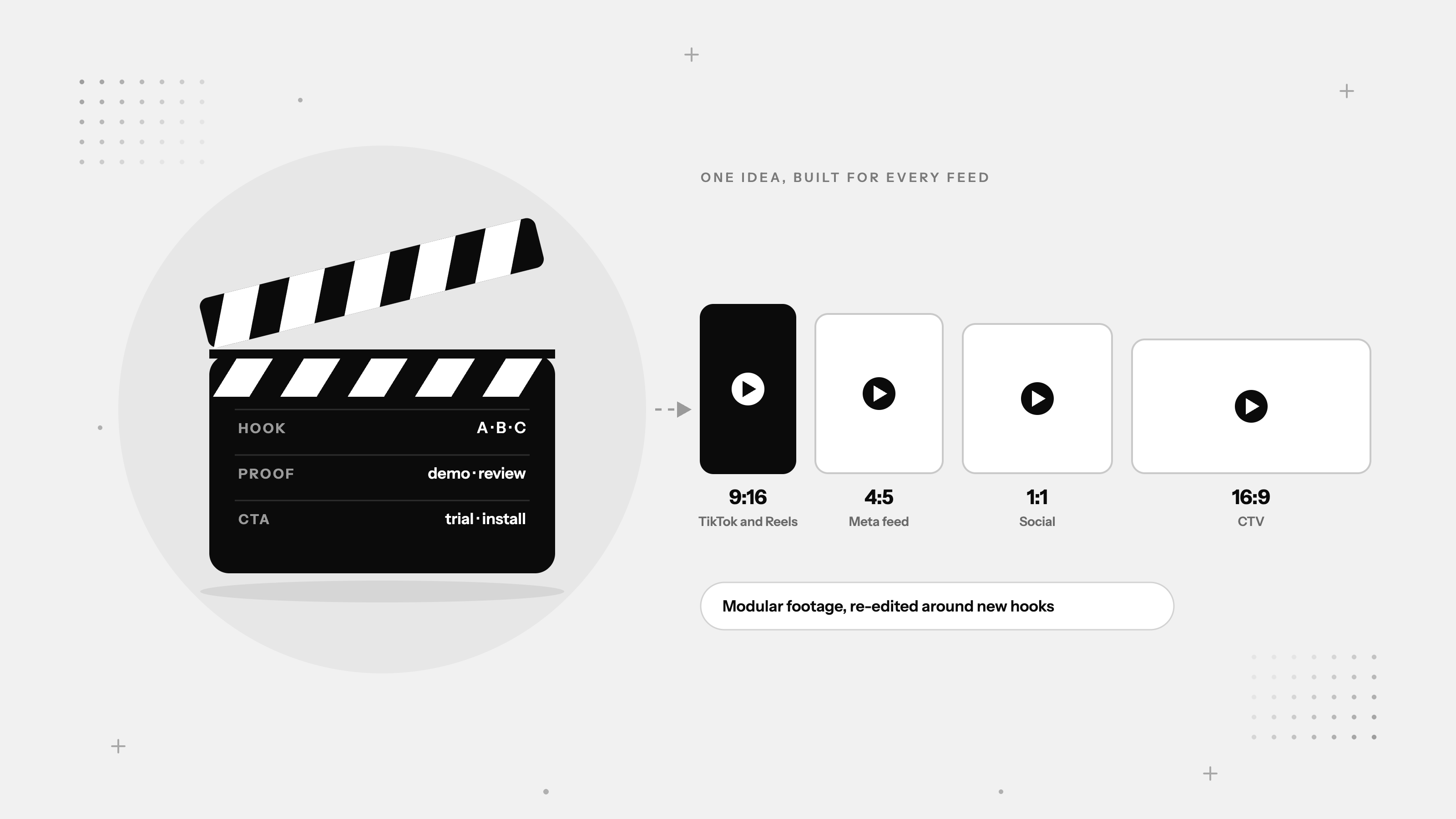
For early-stage testing, prioritize the ability to make cuts, swap hooks, add captions, resize for placements, and use the asset across relevant paid channels. For a proven winner, longer usage and creator-handle authorization may justify additional investment if the platform and audience response support it.
Be equally clear on compliance. Health, financial, children’s, and regulated-product claims need guardrails before the creator turns on the camera. Give creators approved language and prohibited claims, but leave room for natural phrasing. Over-scripted compliance often creates ads that are technically safe and commercially lifeless.
Treat Creators as Part of Your Testing System
The fastest teams do not wait for a campaign to fail before ordering more content. They maintain a production rhythm tied to media learnings. When a hook wins, creators receive the next iteration brief quickly. When a new objection appears in comments or customer research, it becomes a fresh angle to test.
That requires tight coordination between creative strategy, creator management, editing, and paid media. Fragment those roles, and insights get lost between the person buying ads and the person booking talent. Connect them, and every asset becomes a response to a measurable question.
At Scrolling Media, that is the operating model: source creators for the performance job, produce platform-ready variations, and feed live campaign results back into the next creative batch. The point is not to find a creator who makes one nice video. It is to create a supply of ads that keeps giving your acquisition engine new ways to win.
The next creator you hire should not be judged by whether the first cut feels exciting in a review meeting. Judge them by whether they give your team stronger hooks, cleaner tests, and another credible route to lower acquisition costs.