Creative Strategy
Creative Strategy
Incrementality Testing Explained for Growth Teams
Incrementality testing explained for growth teams: learn how holdouts, lift studies, and creative experiments expose the ads that truly drive growth.

Your Meta dashboard says the campaign drove 10,000 purchases. The real question is harsher: how many of those customers would have purchased anyway? Incrementality testing explained in plain terms is the discipline of separating credited conversions from conversions your advertising actually caused.
That distinction changes budget decisions. Attribution tools are built to assign credit. Incrementality tests are built to measure causal impact. If your team is scaling paid social, app installs, subscription trials, or mobile game revenue, you need both. But when they disagree, incrementality deserves the final word.
What Incrementality Testing Actually Measures
Incrementality measures the lift created by an action. In paid acquisition, that action might be showing an ad, increasing spend in a market, running a new creative concept, or activating a creator campaign.
A clean test compares two otherwise similar groups. The treatment group receives the advertising exposure. The control group does not, or receives materially less exposure. The difference in business outcomes is incremental lift.
If 5% of the exposed group converts and 4% of the control group converts, the incremental lift is one percentage point. That may sound small until you apply it to a large audience and a serious media budget. It also means 80% of the conversions credited to the campaign may have happened without it. That is not a reason to stop advertising automatically. It is a reason to stop treating platform-reported conversions as ground truth.
The metric you use depends on the business model. For an app, it may be incremental installs, activated users, trial starts, or subscribers. For ecommerce, it could be first purchases, revenue, or contribution margin. For a mobile game, install lift is useful, but incremental payers and downstream revenue are usually the decision metrics that matter.
Incrementality is not a vanity measurement exercise. It answers practical questions: Should we keep funding retargeting? Is prospecting actually expanding demand? Did the new hook create net-new customers, or did it simply win more credit inside the attribution window? Is a creator partnership adding reach that paid ads were already capturing?
Incrementality Testing Explained: The Core Methods
There is no single perfect test. The right design depends on audience size, media channels, conversion volume, privacy constraints, and how much risk the business can tolerate during the experiment.
User-Level Holdouts
User-level holdouts are the cleanest option when a platform or data environment can randomly withhold ads from a portion of an eligible audience. One group is eligible for delivery; the other is not. Because assignment is random, differences in outcomes are more likely to be caused by the campaign.
This works well for large-scale activity with enough conversion volume. It is especially useful when evaluating retargeting, suppression strategies, or an always-on acquisition program. The trade-off is operational: holding out users can reduce short-term attributed volume, and the platform may limit exactly how the test is configured.
Geographic Experiments
Geo tests split comparable markets into treatment and control groups. You might increase TikTok spend across selected DMAs while maintaining a lower baseline in matched markets, then compare the change in outcomes between both groups.
Geo testing is valuable when user-level holdouts are unavailable or when you want to measure cross-channel effects. A Connected TV campaign, influencer activation, and paid social push may all influence search demand, direct traffic, and branded conversion behavior. A geo test can capture more of that total impact than a single-platform report.
The weakness is noise. Markets are not identical. Seasonality, local competition, weather, promotions, app store featuring, and organic creator momentum can all distort results. Strong geo tests use historical data to match markets, run long enough to absorb daily volatility, and avoid changing five other major variables mid-test.
Platform Conversion Lift Studies
Major ad platforms offer conversion lift studies that use randomized control groups within their ecosystems. These can be faster to launch than a custom experiment and are often useful for validating whether a channel creates lift beyond modeled attribution.
Treat them as one source of evidence, not a blank check. Platform studies have defined eligibility rules, minimum spend levels, conversion requirements, and measurement boundaries. They can tell you whether Meta or TikTok created lift among people they could randomize and observe. They cannot fully explain what happened across your entire media mix.
Time-Based Tests
Some teams pause spend, observe the result, then restart it. This is tempting because it is easy. It is also the weakest method when used alone. Demand shifts over time, competitors change bids, and consumers do not behave the same way in week one and week four.
Time-based tests can still be directionally useful for smaller accounts or channels with limited experimentation options. Just do not call a pause test causal proof unless you have controlled for the other forces moving the business.
Start With the Budget Decision, Not the Test Format
The best incrementality test is designed around a decision someone is prepared to make. “We want to learn more” is not enough.
A better starting point sounds like this: if branded search retargeting has less than 10% incremental lift, reallocate 30% of that budget into broad prospecting. Or: if creator-led TikTok ads produce incremental trial starts at our target cost, expand the creator roster and build paid amplification around the top three concepts.
Define the primary outcome before launch. Choose one metric that represents value, plus a small set of guardrails. A subscription app may optimize around incremental paid subscriptions while watching trial-to-paid rate and refund rate. A game studio may use incremental day-seven revenue while monitoring install quality and payer rate.
Then set the test duration and sample size based on expected lift, not patience. Small effects require more volume. If your baseline conversion rate is low or the purchase cycle is long, a one-week experiment will usually produce a confident-looking answer with very little confidence behind it.
Creative Is Part of the Measurement Problem
Most teams think of incrementality as a media measurement issue. It is also a creative issue.
A weak creative test can make a high-value channel look ineffective. If the treatment group receives fatigued assets, generic UGC, or a hook that loses attention in the first second, the test measures weak delivery against no delivery. It does not measure the channel's potential.
This is why creative strategy and media execution should be connected. Test a defined creative hypothesis, not a pile of unrelated ads. For example, a health app might compare outcome-led hooks against credibility-led hooks. A mobile game might test fail-state gameplay, social competition, and progression fantasy. A subscription product might test price friction versus the cost of doing nothing.
The goal is not to find the ad with the highest click-through rate. The goal is to identify the creative angle that generates incremental business value after exposure. Clicks can be cheap. Incremental customers are not.
When a concept wins, do not assume the work is over. Build variations around the winning mechanism: new openings, different creators, alternate proof points, fresh visual pacing, and platform-native edits. This gives the media team new inventory without abandoning the causal insight behind the original result.
Where Growth Teams Get Incrementality Wrong
The most common mistake is testing too many changes at once. If you change creative, targeting, bid strategy, landing page, offer, and budget simultaneously, any lift result becomes difficult to interpret. Keep the treatment clear.
Another mistake is relying on a single attribution window. A seven-day click report and a one-day view report can produce very different narratives, especially for high-frequency channels. Incrementality helps correct that bias, but only if the test reads outcomes from a source that is consistent across treatment and control.
Teams also overreact to short-term results. Prospecting can look inefficient in last-click reporting while creating future branded search, organic installs, and retargeting pools. Retargeting can look exceptionally efficient while harvesting demand already created elsewhere. The answer is not that one tactic is good and the other is bad. It depends on the marginal return at the current spend level.
Finally, do not confuse a statistically significant result with a commercially meaningful one. A tiny lift may be real but still fail to justify the spend. Evaluate incrementality against margin, payback period, retention, and the opportunity cost of putting that budget somewhere else.
Make Incrementality a Repeatable Operating System
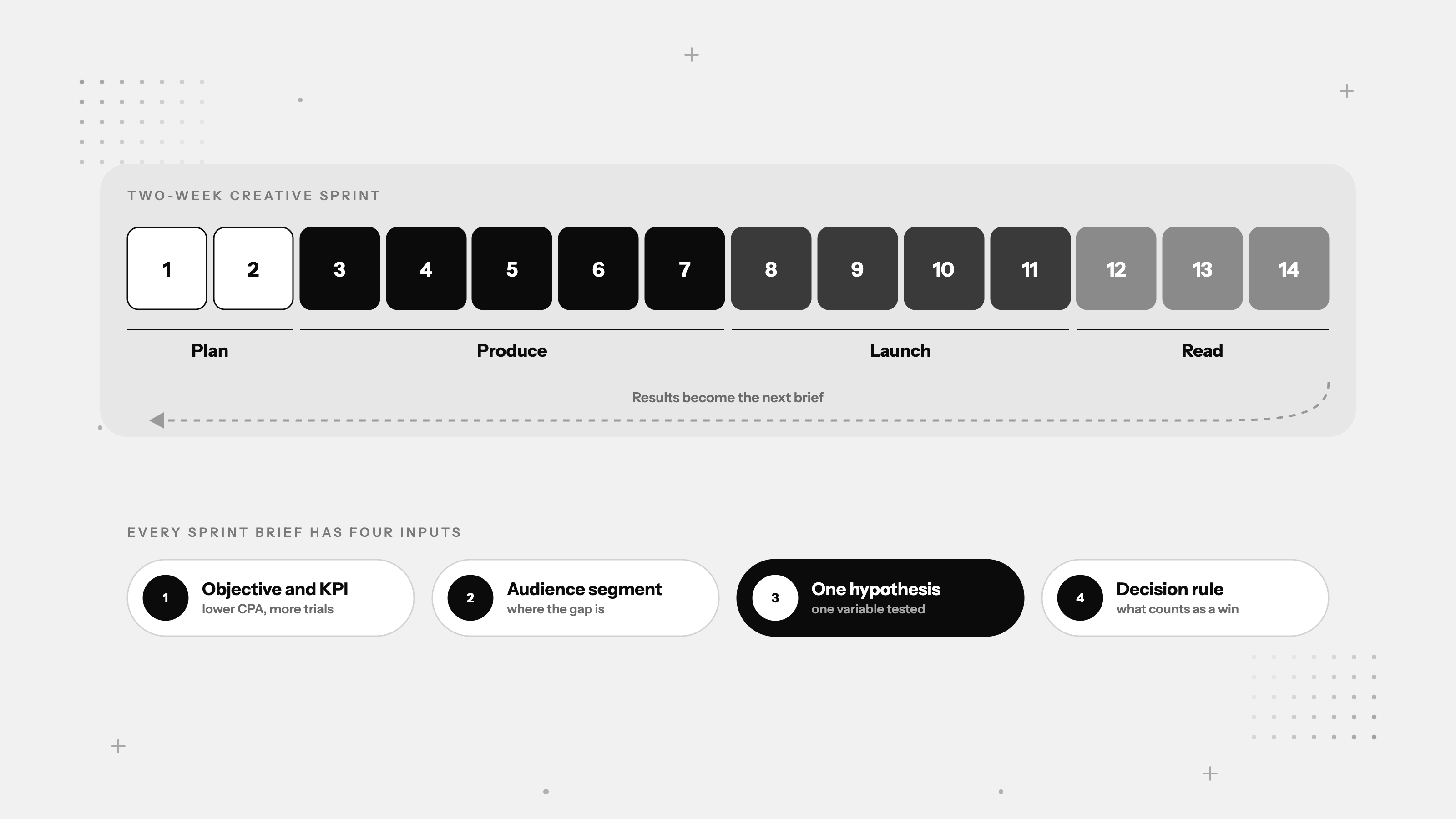
One-off lift studies are useful. A repeatable measurement cadence is better. Establish a testing calendar around major spend decisions: channel expansion, retargeting efficiency, creator programs, new-market launches, and big creative shifts.
Keep a record of the hypothesis, audience, treatment, holdout design, primary metric, confidence level, and decision made. Over time, this becomes far more valuable than another dashboard screenshot. It tells your team where advertising truly creates demand, where it merely captures it, and which creative ideas deserve more production.
The point is not to make every media decision slow or academic. It is to make the expensive decisions harder to fool. When attribution says an ad performed, ask one more question: did it create a customer you would not have had otherwise?