Creative Strategy
Creative Strategy
Meta Ad Creative Testing That Finds Winners Faster
Meta ad creative testing works when you isolate the hook, read the right signals, and turn proven concepts into efficient scalable campaigns at scale.
A $30,000 monthly Meta budget can disappear behind a polished video that never earns attention in the first second. That is why meta ad creative testing cannot be treated as a production review or a beauty contest. It is a system for finding which message, visual tension, proof point, and audience cue can lower acquisition costs in a live auction.
The teams that scale do not ask, “Which ad do we like?” They ask, “What is this ad teaching us about why someone starts, clicks, installs, trials, or buys?” That distinction changes the brief, the test design, and the speed at which a winner becomes a campaign.
Stop Testing Ads. Start Testing Decisions.
An ad is a bundle of variables. Its opening hook, creator, offer, pace, product demo, caption, CTA, sound, and aspect ratio all affect performance. Launch five completely different ads at once and a winning result may tell you very little. Was it the creator’s delivery? The claim? The before-and-after visual? A broad audience receiving more delivery?
Good testing creates an answer worth acting on. Start with a hypothesis tied to a buyer decision. For a wellness app, that might be: people facing a specific daily frustration will respond better to a relatable confession than to a feature-led product tour. For a mobile game, it could be: visible failure in the first two seconds will generate more qualified installs than gameplay footage that starts slowly.
Then build multiple executions around that one decision. Keep enough of the structure consistent that the result is readable. This does not mean every test must be laboratory-perfect. Meta’s delivery system is dynamic, and creative performance is never isolated from audience, placement, optimization event, and auction pressure. It does mean you should know what you intended to learn before spend begins.
A useful creative testing roadmap usually moves from broad concept questions to tighter execution questions. First test the angle: pain point, aspiration, social proof, comparison, challenge, or offer. Once an angle earns attention and conversion, test the hook variations within it. Then test proof, pacing, creator casting, and ending mechanics. Testing button colors while the core message is weak is just organized procrastination.
Build a Meta Ad Creative Testing Framework Around the Funnel
Creative has different jobs at different points in the funnel. A cold prospect needs fast relevance. A warm visitor may need proof, objection handling, or a reason to act now. Retargeting a user with the same broad-awareness video can inflate frequency without moving revenue.
For prospecting, judge creative on its ability to interrupt the feed and attract the right people. Thumb-stop behavior, three-second view rate, hold rate, click-through rate, and landing page engagement can help diagnose what happens before conversion. These are directional signals, not victory laps. A high click-through rate paired with weak trial starts or purchases often means the ad is creating curiosity without qualifying intent.
For conversion-focused campaigns, CPA, cost per trial, cost per install, purchase volume, and ROAS carry more weight. The right primary metric depends on your business model and optimization maturity. A subscription app with delayed retention data may initially optimize toward trials, then evaluate whether a creative attracts subscribers who stay. An ecommerce brand with fast purchase feedback can make revenue efficiency the lead signal sooner.
Do not force every asset to win on every metric. A disruptive creator-led hook may earn cheap clicks but need a stronger product demonstration in the middle to convert. A direct-response offer ad may have a lower click-through rate but produce better buyers. Read the full path before killing or scaling an asset.
Test Enough Variants to Learn, Not Just to Launch
One new video per week is not a testing program. It is a hope strategy. Yet volume without a system also creates noise, drains budgets, and leaves creative teams chasing random outcomes.
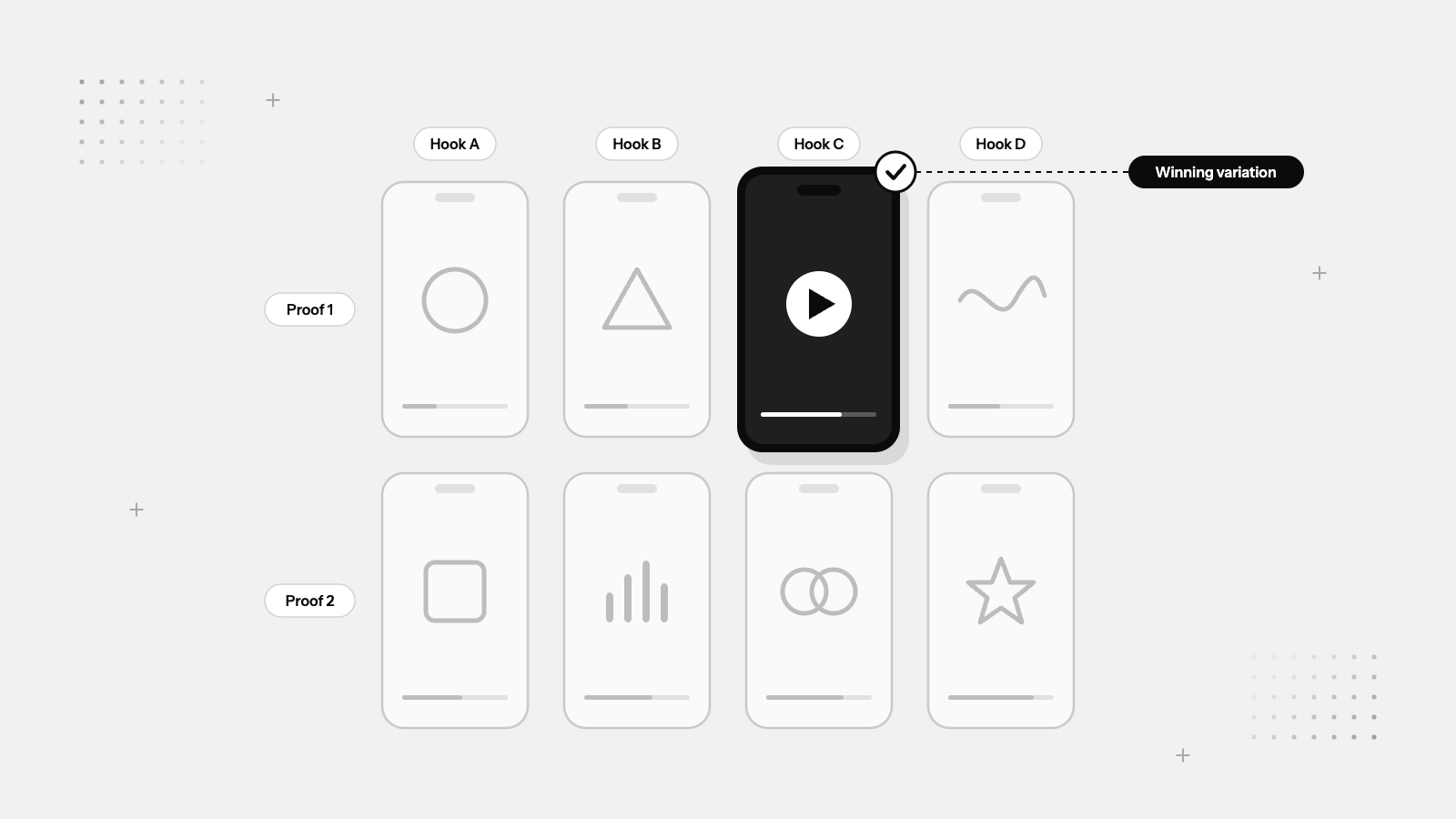
A practical monthly cadence starts with a small number of strategic territories, then gives each territory enough executions to reveal patterns. For example, a consumer subscription brand could test four distinct angles: a problem-first creator confession, an expert explanation, a customer-results story, and a direct offer. Each angle might have three to five hook variants, with changes to the first line, opening visual, or first proof point.
That produces a meaningful creative batch without pretending that 40 unrelated videos are a strategy. Once early signals appear, produce follow-on iterations quickly. The first winner is rarely the final winner. It is the source material for a second round that can sharpen the opening, remove friction, add proof, or adapt the concept for a new audience segment.
Creative volume should match spend. A brand spending $10,000 a month cannot fund the same test matrix as a brand spending $500,000. At lower budgets, prioritize larger concept differences and avoid splitting delivery across too many ad sets. At higher budgets, build a disciplined pipeline that supplies fresh angles before fatigue shows up in reporting.
Separate Exploration From Scaling
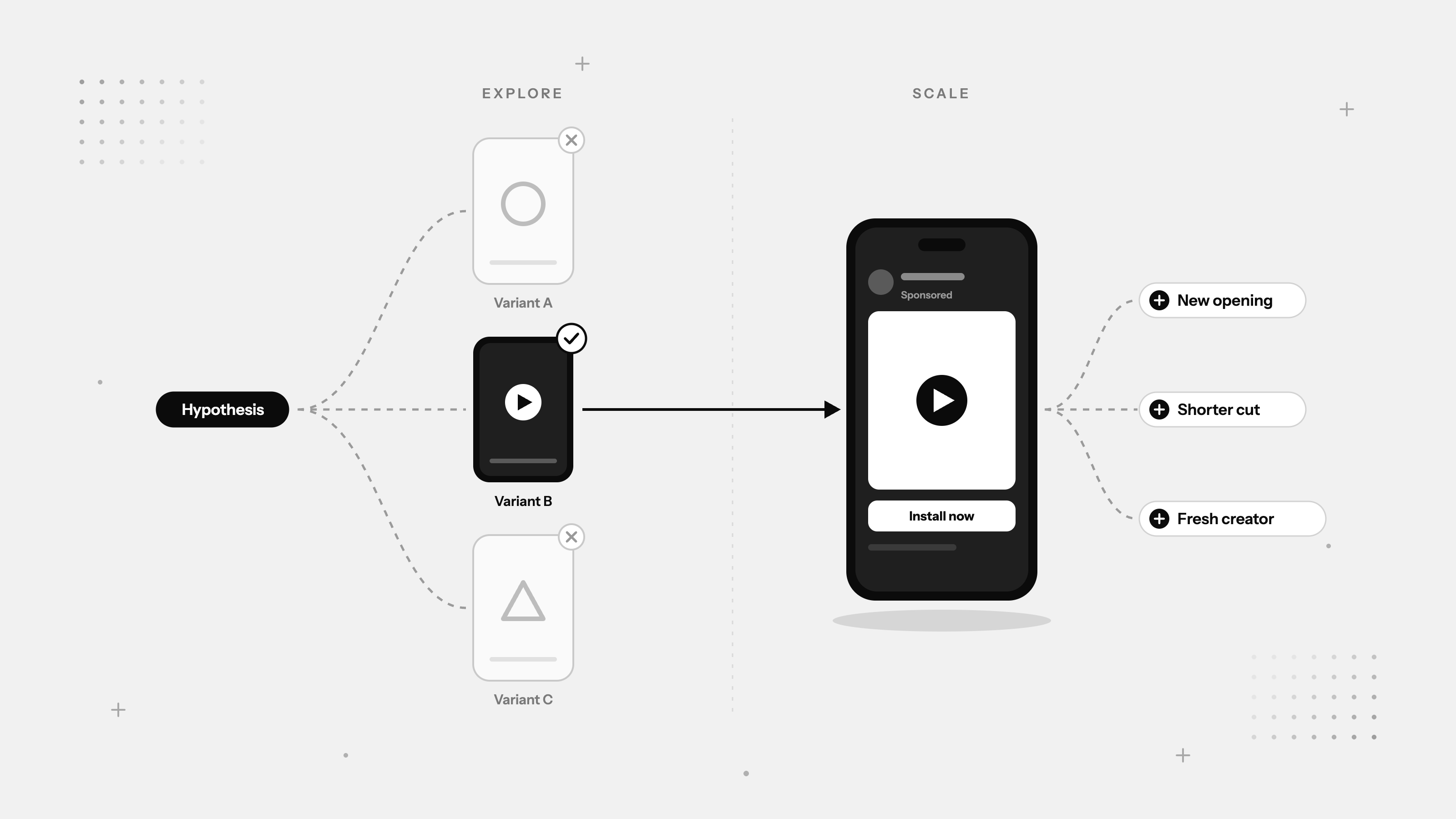
Exploration needs permission to lose. Scaling needs stability. Mixing the two inside the same campaign structure often makes both harder.
Use an exploration environment to introduce new concepts with controlled budgets and clear learning goals. Give ads enough delivery to gather a credible signal, but do not let a promising early result consume spend that belongs to proven performers. The exact threshold varies with conversion volume, purchase cycle, and CPA. A low-volume, high-consideration product needs more patience than a mobile game with thousands of daily installs.
When a concept proves it can hit efficiency targets, move it into a scaling setup where it can receive meaningful spend. Preserve the winning mechanism before making major edits. Too many teams find a strong hook, then immediately replace the creator, rewrite the script, change the offer, and recut the pacing. They have not iterated. They have started over.
Scale through controlled variations. Keep the central promise intact while testing fresh openings, new creators, alternate proof, shorter cuts, and placement-native edits. A winning 30-second feed ad may need a different opening frame or text treatment for Reels and Stories. Platform-native is not a stylistic preference. It affects whether the ad feels like content or an interruption.
Diagnose Fatigue Before Performance Falls Apart
Creative fatigue is not simply an ad that has been live for a long time. It is a loss of efficiency caused by repeated exposure, audience saturation, competitive pressure, or a shift in what the market responds to. Frequency can be a clue, but it is not a verdict.
Watch for rising CPA alongside declining click-through rate, weakening hold rates, and fewer conversions from assets that once carried spend. Compare performance by audience, placement, and spend level. A creative may be exhausted in a narrow retargeting pool while still working in broad prospecting. Killing it everywhere leaves money on the table.
The best defense is not emergency production after results collapse. It is a standing creative pipeline. Maintain a mix of new concepts, iterations of current winners, seasonal or promotional assets, and evergreen proof-driven ads. That gives media buyers options when delivery shifts and keeps creative strategy connected to what the account is actually seeing.
Make Reporting Useful to the People Making Ads
A report that says “Video 12 won” is not useful. The next brief needs to explain why it likely won and what should happen next.
Tag assets by angle, hook type, creator profile, product feature, proof mechanism, visual format, and CTA. Over time, these tags expose patterns that individual ad names hide. You may learn that founder-style explanations drive higher-quality trials, that challenge hooks work only when gameplay appears immediately, or that discount-led ads produce purchases but damage first-order profitability.
Pair performance data with qualitative review. Read comments. Watch where viewers drop off. Look at landing page alignment. If an ad promises one thing and the page opens with something else, creative may get blamed for a conversion leak it did not create.
At Scrolling Media, this is where creative strategy and paid media management have to operate as one team. Production without delivery feedback is expensive guesswork. Media buying without a reliable creative engine eventually runs out of room to improve.
The Goal Is a Repeatable Advantage
Meta ad creative testing is not about crowning one perfect ad. Markets move, audiences get bored, and competitors copy what works. The real asset is a learning loop that turns live performance into stronger briefs, faster iterations, and more efficient acquisition.
Treat every winner as evidence, not an endpoint. When your team can explain the buyer tension behind the result, preserve it in the next round, and ship new variations before fatigue arrives, creative stops being a recurring bottleneck. It becomes one of the few growth levers you can actively build.