Mobile Games Ads
Mobile Games Ads
TikTok Ads for Mobile Games Built to Scale
TikTok ads for mobile games work when gameplay, hooks, creators, and media buying operate as one testing system built to lower CPI while scaling returns.
A mobile game can have polished art, a strong core loop, and positive store ratings, then still lose on TikTok because the first second of the ad gives people no reason to stop scrolling. TikTok ads for mobile games are not won by production value alone. They are won by a creative system that turns real gameplay tension into a clear reason to install.
That distinction matters because TikTok is both a discovery channel and a ruthless feedback loop. The platform quickly tells you whether an opening visual earns attention, whether the concept attracts the right player, and whether that player becomes valuable after the install. Studios that treat TikTok as a place to upload trailers tend to burn budget. Studios that treat it as a live creative testing engine find scalable acquisition angles.
Why TikTok Changes Mobile Game UA
TikTok rewards native behavior, not traditional game advertising. Players are used to fast cuts, creator commentary, reaction formats, challenge videos, odd visual payoffs, and direct opinions. A cinematic launch trailer can support a brand moment, but it rarely supplies the volume of testable variations needed to control CPI over time.
The platform also compresses the distance between creative and media performance. A stronger hook can improve thumb-stop rate. Better early engagement can create more efficient delivery. More qualified installs can improve downstream optimization. Those effects compound, which is why creative is not a finishing touch for user acquisition. It is a buying lever.
This does not mean every winning TikTok ad needs to look messy or creator-made. It means the ad needs to earn attention before it asks for action. For a merge game, that may be a near-complete board and one satisfying final move. For a strategy title, it may be a disastrous decision that viewers immediately want to correct. For a casual puzzle game, it may be an impossible-looking level with a simple, visible objective.
The job is not to explain every system in the game. The job is to make the right player feel the pull of one moment.
Build TikTok Ads for Mobile Games Around Hooks
Stop testing ads. Start testing hooks.
Most creative teams still organize tests around broad labels such as “new gameplay video” or “new UGC ad.” That is too vague to produce learning. A usable TikTok test separates the variables that drive attention from the elements that prove the product.
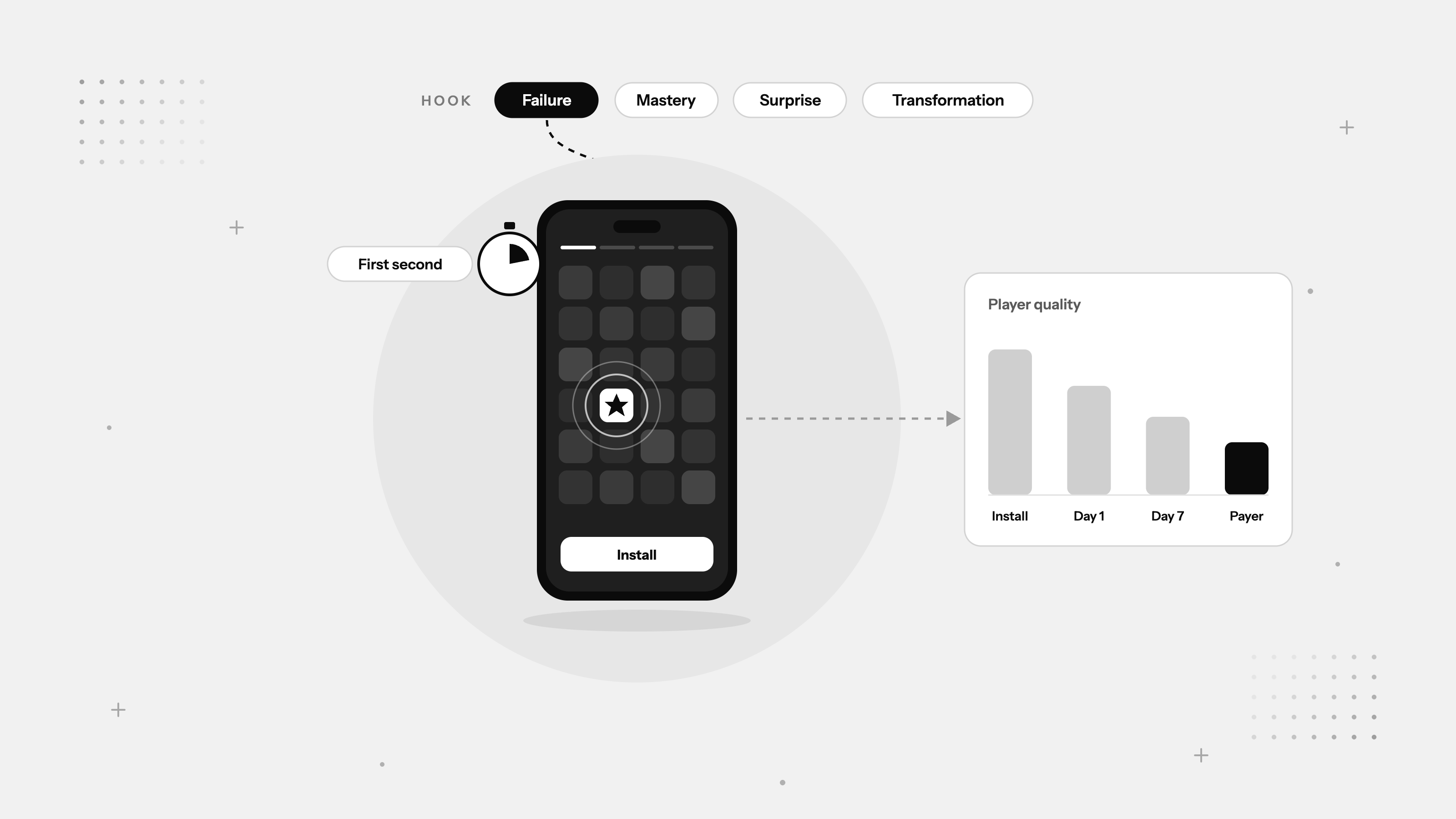
Start with a hook library built around the actual motivations behind your game. Competition, collection, mastery, transformation, relaxation, surprise, social identity, and failure are all potential territories. Then write multiple executions inside each territory. “Can you beat this level?” is not a testing strategy. Showing a player fail at the last move, calling out the mistake in on-screen text, and immediately replaying the solution is a specific hook.
The first one to two seconds should carry a visual event, a clear premise, or a tension point. Avoid slow logo reveals, generic character introductions, and setup copy that only makes sense after five seconds. On a feed built for velocity, delayed context is expensive.
From there, let gameplay do the selling. Show the input, decision, reward, progression, or consequence that makes the game worth downloading. The strongest ads often move from interruption to proof: a surprising opening, followed by real footage that confirms the game can deliver on the promise.
That last part matters. Fake-game-ad mechanics may produce cheap clicks, but they can damage conversion quality, retention, reviews, and long-term trust when the install experience does not match the ad. There is room for dramatization and edited storytelling. There is not much room for misleading the player you just paid to acquire.
Use Creators as a Performance Format, Not a Branding Add-On
Creator-led ads can work exceptionally well for mobile games, but only when the creator is selected and briefed for performance. Follower count is not the operating metric. You need a person who can make gameplay feel social, understandable, and worth reacting to in a vertical video.
A creator can frame a game as a personal challenge, a guilty pleasure, a family competition, or a surprisingly strategic obsession. That human framing can turn a feature into a reason to care. But the creator should not spend half the ad introducing themselves. Their role is to accelerate credibility and comprehension.
The best creator briefs protect room for natural delivery while holding firm on the performance requirements. Define the first-frame concept, gameplay sequence, talking points, audience objection to address, and call to action. Ask for several hook options, not one polished read. A creator saying the same script three times is not meaningful creative coverage.
For kids and family-oriented games, the guardrails are tighter. Age-appropriate presentation, accurate gameplay, and clear review processes are non-negotiable. The creative can still be energetic and platform-native without borrowing trends that do not fit the audience or the product.
Measure the Full Funnel, Not Just the Install
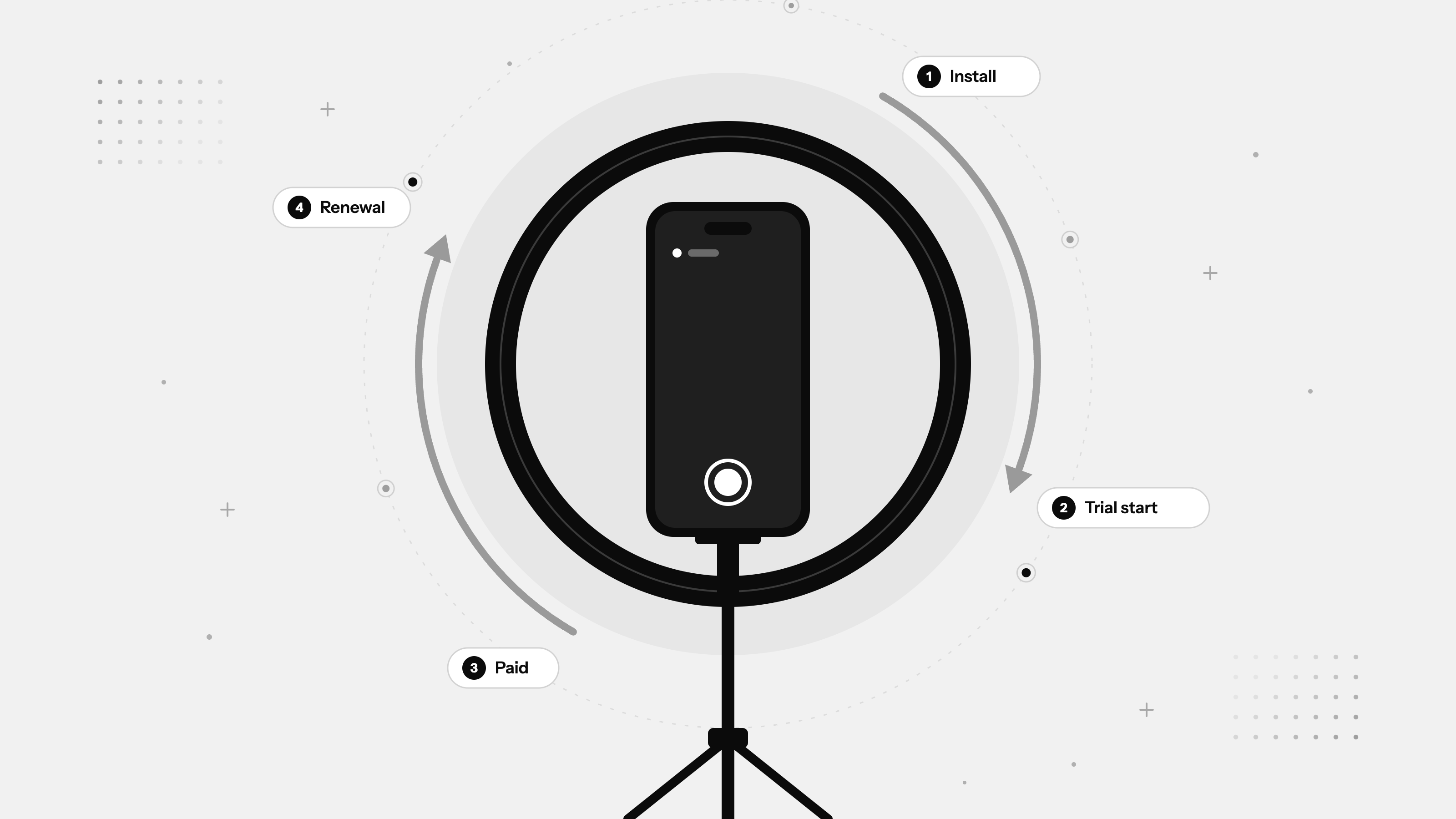
A low CPI is only a win if it leads to players who matter. TikTok can efficiently find broad reach, which makes downstream measurement essential for games with subscription trials, in-app purchases, ad monetization, or longer payback windows.
At the creative level, watch early indicators such as hold rate, average watch time, click-through rate, and install rate. These metrics help diagnose where an ad breaks. A weak hold rate often points to an ineffective opening. Strong viewing but weak installs can signal unclear gameplay, a mismatched call to action, or an ad that entertains without selling.
Then connect those signals to the metrics that pay the bills: cost per install, cost per activated user, tutorial completion, day-one and day-seven retention, payer rate, cost per trial, and ROAS. The exact optimization event depends on the game and its data volume. A new title may need to optimize toward installs or early in-app events before it has enough purchase data. A mature game with reliable revenue signals can push further down funnel.
Do not declare a creative winner after a handful of cheap installs. Segment results by concept, hook, audience, placement, and optimization event. A high-CPI ad that drives materially better payer quality may deserve more budget than a cheap-install concept with poor retention. It depends on your monetization model and payback target.
Campaign Structure Should Preserve Learning
Over-segmented TikTok accounts create noise. If every concept has its own tiny ad group, delivery fragments and the team learns slowly. If everything is piled into one campaign with no naming discipline, strong concepts disappear inside an unreadable data set.
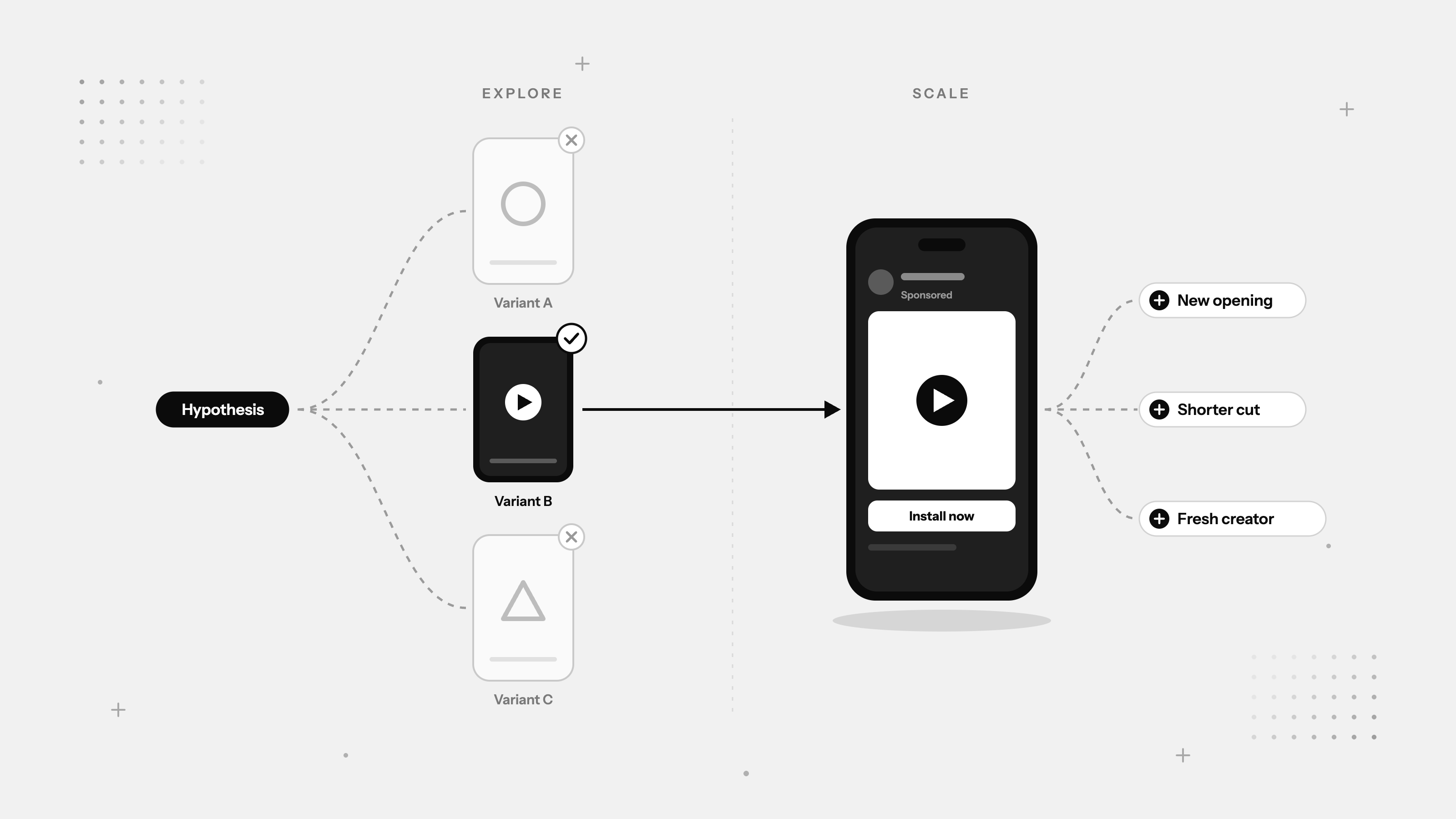
A practical structure gives the platform enough room to learn while keeping the creative analysis clean. Separate prospecting from retargeting when both are relevant. Group tests around meaningful optimization goals. Keep a dedicated testing lane for new concepts, then move validated winners into a scaling environment with enough budget to prove durability.
Creative fatigue is not a calendar problem. It is a performance problem. Some assets decay within days; others run for weeks because the concept is broad, the gameplay is satisfying, or the audience is still expanding. Monitor frequency alongside CPI, conversion quality, and spend concentration. Replacing every ad on a fixed schedule is wasteful. Waiting until performance collapses is worse.
A useful production cadence keeps multiple ideas moving at once: new hooks, new gameplay cuts, creator variations, visual refreshes, and iterations on proven concepts. The goal is not endless volume for its own sake. It is enough qualified creative supply to prevent media buying from outrunning the ad account's ability to learn.
Scale What the Data Can Explain
When a TikTok ad starts spending, resist the urge to recreate it with superficial changes. Identify why it works. Was it the opening failure? The visual transformation? The creator's tone? The visible reward? The simple explanation of a deeper system?
Then create adjacent tests that preserve the core mechanism while changing the execution. If a “wrong choice” hook wins for a survival game, test different wrong choices, stakes, character types, and endings. If a satisfying merge sequence works, test the same progression with different starting states and on-screen claims. This is how a one-off hit becomes a creative territory.
Scaling also requires restraint. Raising budgets too aggressively, changing targeting and creative at once, or optimizing toward a deeper event before there is enough conversion volume can make a good ad look broken. Make changes with a clear hypothesis and give the data enough time to answer.
Scrolling Media approaches this work as one connected growth system: strategy identifies the angle, production builds platform-ready variations, and media buying turns results into the next brief. That closes the gap between what gets made and what actually scales.
The next winning TikTok ad may not look like your most expensive asset. It will look like a sharp understanding of why someone would stop, watch, install, and come back tomorrow. Build for that sequence, and let every round of spend make the next round smarter.