Influencer Marketing
Creative Strategy
Creative Strategy for Paid Social That Scales
Creative strategy for paid social turns performance data into better hooks, platform-native assets, faster learning, and more efficient growth at scale.
Most paid social accounts do not have a media buying problem. They have a creative throughput problem disguised as a media buying problem. When CPA climbs, teams often adjust bids, audiences, or budgets first. But if the same tired message is being served to the same increasingly saturated audience, better targeting will only delay the issue.
A strong creative strategy for paid social treats every ad as a testable acquisition hypothesis. It connects audience insight, offer, format, hook, production, and media performance into one operating system. The point is not to make more content. The point is to produce a reliable stream of ads that can earn attention and convert it into installs, trials, purchases, or revenue.
Creative Strategy for Paid Social Starts With the Job
Creative is not decoration for a media plan. It is the delivery mechanism for the media plan.
That distinction matters because paid social is an interruption environment. A user is not looking for your app, subscription, or game when your ad appears. You have a fraction of a second to make the value exchange clear enough to stop the scroll. If the opening does not create curiosity, recognition, aspiration, or urgency, the rest of the asset never gets a chance.
The job of creative strategy is to decide what deserves testing before production begins. That means identifying the audience tension, the product proof, the offer, and the format most likely to make a prospect care. It also means setting a performance goal. A video optimized for low-cost reach is not necessarily built to drive a high-intent trial. A polished brand asset may look right for Connected TV but underperform as a direct-response TikTok ad.
The best strategy is specific about the outcome. For a mobile game, that may be a lower cost per install without sacrificing downstream retention. For a wellness subscription, it may be more qualified trials at a target payback period. For an ecommerce brand, it may be improving new-customer ROAS while preserving margin. Different business models need different creative signals.
Stop Testing Ads. Start Testing Hooks.
A common testing mistake is treating each completed video as one idea. It is not. An ad is a bundle of variables: the first-frame visual, opening line, creator, customer problem, proof point, product demonstration, offer, edit pace, call to action, and placement.
If five ads launch with different scripts, creators, offers, and visual styles, a winning result tells you very little. You know one asset worked. You do not know why. That makes the next production cycle slower and more expensive.
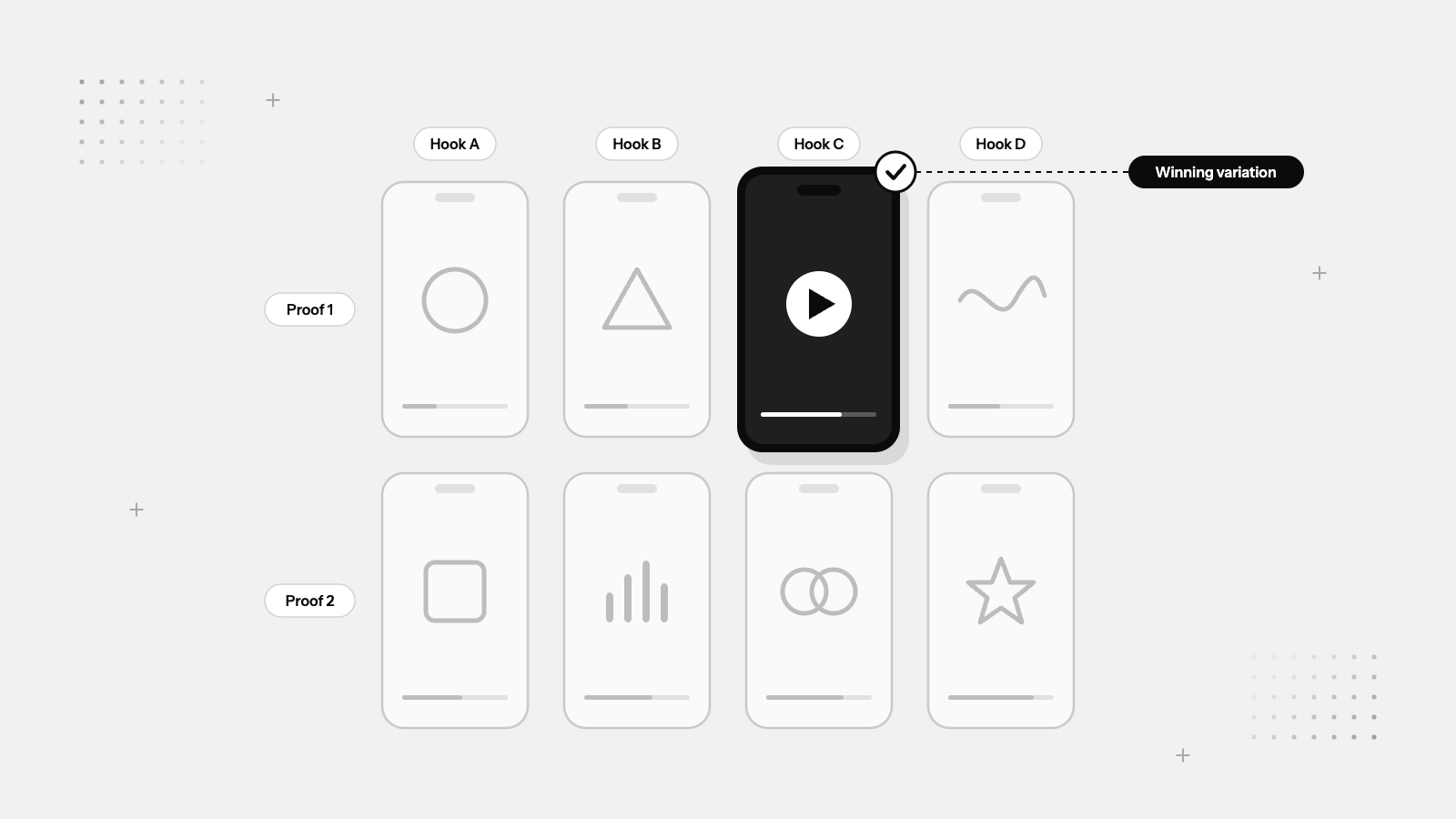
Instead, isolate the message variable that matters. Test several hooks against a consistent body. Then test different proof mechanisms for the hook that wins. Once the core message is working, test formats, talent, pacing, and calls to action. This is how a creative team turns campaign results into reusable learning rather than a folder full of disconnected videos.
For example, a sleep app may begin with three distinct angles: “I stopped waking up at 3 a.m.,” “my bedtime routine was making sleep worse,” and “a five-minute wind-down that actually stuck.” Each angle speaks to a different tension. The winner can then be expressed through a creator testimonial, a product walkthrough, a comparison, or a motion-led demonstration. The concept stays constant while execution evolves.
This approach does not mean every test must be scientifically pure. Platform delivery is messy, spend levels vary, and audiences overlap. But teams should be disciplined enough to preserve the signal. If every element changes at once, there is no learning loop to scale.
Build Around Evidence, Not Internal Preference
The strongest creative ideas usually come from a mix of qualitative research and live performance data. Neither source is enough on its own.
Research reveals the language customers use, the objections they repeat, the alternatives they compare, and the outcomes they actually want. Reviews, creator comments, support tickets, onboarding feedback, competitor ads, and customer interviews are all useful inputs. They can expose the difference between the benefit a brand wants to lead with and the benefit customers respond to.
Performance data shows whether that message holds up in the feed. Watch time, thumb-stop rate, click-through rate, conversion rate, CPA, and ROAS each tell part of the story. A high click-through rate with weak conversion may signal a misleading hook or a landing-page mismatch. A low click-through rate with strong conversion can point to an offer that resonates deeply but needs a stronger opening.
Do not use one metric to judge every asset. For direct-response campaigns, the final business outcome matters most. Still, diagnostic metrics are how you identify where the creative is failing. A paid social strategy that only looks at blended results can miss the fix that would materially improve efficiency.
Make the Asset Native to the Placement
A single video resized for every channel is not a platform strategy. It is a production shortcut.
Meta, TikTok, YouTube, and Connected TV create different viewing behaviors and demand different creative choices. TikTok often rewards immediacy, human delivery, active visual changes, and a point of view that feels native to the feed. Meta can support broader format variation, from testimonial-led vertical video to static comparison ads and carousel-based education. Connected TV needs a clearer narrative arc and production quality that can hold up on a large screen, while still landing one direct response message.
The right format also depends on product complexity. A mobile game may need raw gameplay in the first second, followed by a visible challenge and payoff. A finance app may require trust signals and an easy product demonstration before it can credibly ask for a download. A consumer subscription product may benefit from creator-led proof because the buyer needs to see someone like them using it in a real context.
Platform-native does not mean unpolished by default. It means intentional. Some campaigns need scripted UGC. Others need AI animation to visualize a hard-to-film benefit, motion graphics to clarify a product flow, or custom HTML5 playable ads that turn gameplay into the acquisition experience. The format should serve the conversion job, not a production trend.
Create a Production System That Can Keep Up
Creative fatigue is not a surprise. It is the normal result of showing a finite pool of ads to an audience over time. The answer is not random volume. It is a production engine that can generate meaningful variation without restarting strategy every month.
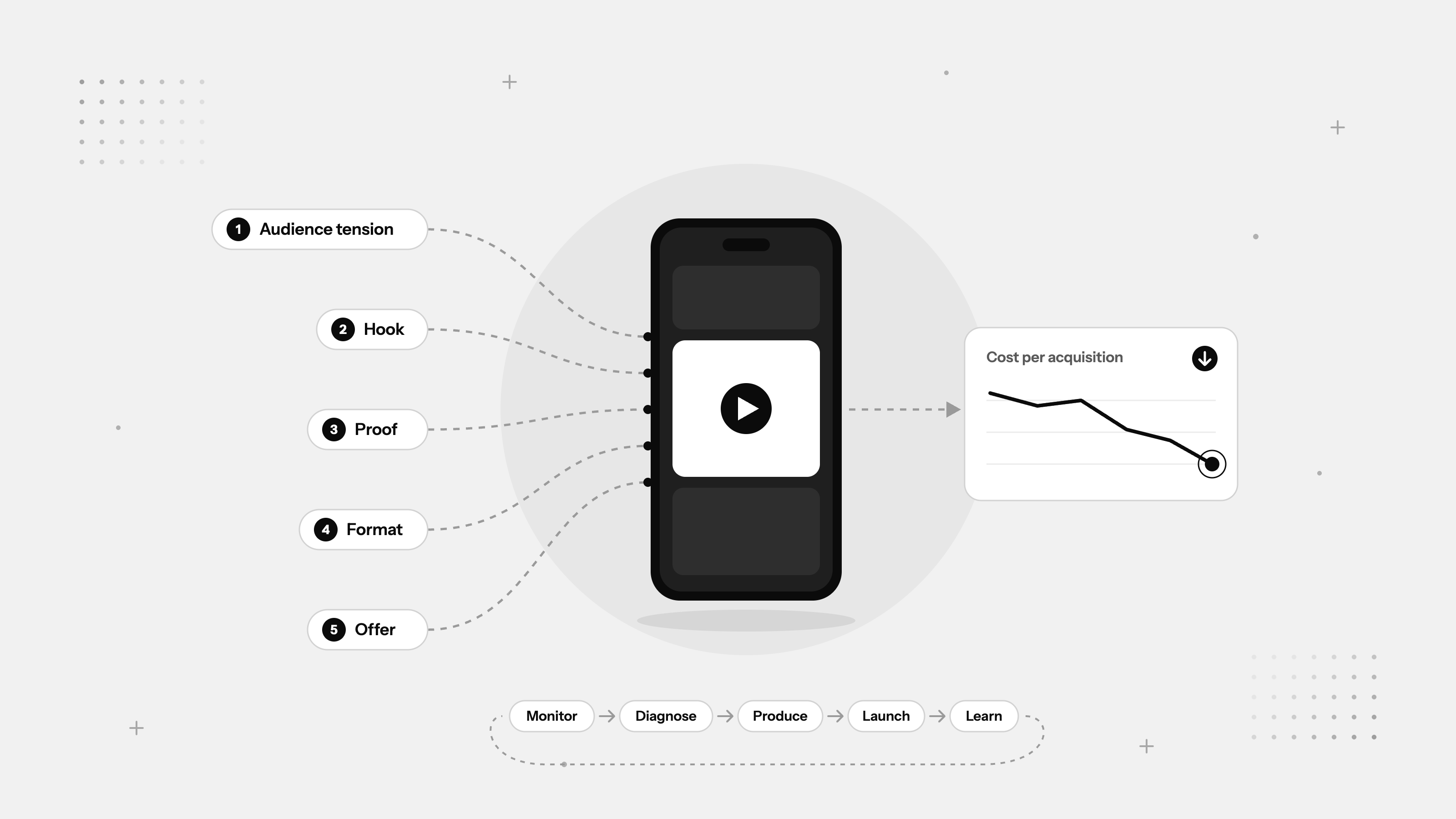
Start with a concept matrix. Organize potential assets across a few high-value dimensions: audience tension, hook type, proof source, format, and offer. This creates a clear view of what has been tested, what is working, and where the gaps are. A team may find that it has tested plenty of creator faces but only one customer objection, or dozens of gameplay edits but no clear progression narrative.
From there, build modular production. Capture enough raw material to produce multiple hook openings, cutdowns, captions, endings, and aspect ratios. Brief creators around specific claims and scenes rather than asking for generic “authentic” content. Give editors a testing plan, not just a script. Production becomes far more efficient when each shoot is designed to yield a family of controlled variations.
Speed matters, but so does quality control. Claims must be supportable. Brand guardrails still apply. And a faster creative cycle is useless if media teams cannot name the assets correctly, read results quickly, and feed insight back into the next brief.
Let Media Buying and Creative Work as One Team
The split between creative and paid media is one of the most expensive habits in performance marketing. Creative teams often hear that an ad “did not work” without knowing whether it failed to earn attention, drive clicks, or convert. Media buyers may see performance decline but lack enough new assets to respond before costs rise.
A better operating rhythm puts both teams in the same review. Look at spend concentration, fatigue signals, audience response, placement performance, and conversion quality together. Decide which winners should receive more variants, which promising ideas need a different execution, and which concepts should be retired.
This is where an integrated partner has an advantage. At Scrolling Media, creative strategy, creator coordination, production, and paid acquisition are connected to the same commercial goal. The feedback loop is shorter because the people making the next asset understand what happened to the last one in-market.
There is no fixed rule for how often to refresh creative. A high-spend app campaign may need new variants weekly. A niche, lower-frequency product may have more runway. The right cadence depends on spend, audience size, platform, and how quickly performance decays. What should not vary is the discipline: monitor, diagnose, produce, launch, learn, repeat.
The next winning paid social ad is rarely hiding in a bigger budget. It is usually hiding in a sharper customer tension, a stronger first second, or a more useful interpretation of the data already sitting in your account.