Creative Strategy
Creative Strategy
Media Budget Allocation That Actually Scales
Media budget allocation works when spend follows evidence, not channel habits. Build a faster system for creative testing, scale, and efficient growth.

A larger paid media budget does not fix a weak acquisition system. It makes the weak parts more expensive. Media budget allocation should decide where the next dollar can produce the most profitable learning or the most efficient growth, not reward the channel that happened to get funded first.
For growth teams buying on Meta, TikTok, Google, AppLovin, or Connected TV, the allocation question is never just channel versus channel. It is also creative versus media, prospecting versus retargeting, proven concepts versus new tests, and short-term CPA versus the customer value those campaigns create. Get those decisions right and spend can scale with control. Get them wrong and performance looks fine until it suddenly does not.
Start With the Constraint, Not the Channel
Most budget plans begin with a familiar split: a percentage for Meta, a percentage for Google, perhaps a smaller number for TikTok or creators. That is easy to present in a planning deck. It is also backward.
Start with the business constraint. Is the priority volume, payback period, trial quality, purchase rate, or a specific ROAS target? A mobile game optimizing for installs can tolerate a different learning curve than a subscription app that needs paid conversions within a defined window. An ecommerce brand with strong repeat purchase behavior can bid differently than a product with thin margins and a one-time sale.
Your allocation needs a primary efficiency metric and a guardrail metric. For example, cost per trial may be the primary metric, while trial-to-paid conversion is the guardrail. For a game, CPI may lead, while retention or payer conversion prevents the team from buying cheap but low-value users. Without the guardrail, the platform will find inexpensive volume that can quietly damage unit economics.
Then define the budget's job. A mature campaign budget can be expected to deliver. A test budget should be expected to reduce uncertainty. Treating both as if they have the same job leads to premature cuts on useful tests and overfunding of campaigns that have already plateaued.
Build Media Budget Allocation Around Three Pools
A practical media budget allocation model separates spend into three working pools: core, scale, and exploration. The percentages will move by business maturity, creative supply, and seasonality, but the separation matters more than any universal benchmark.
The core pool supports campaigns with stable conversion data, proven creative angles, and predictable economics. This is not a place to chase every platform trend. Its role is to protect efficient volume. If Meta prospecting consistently produces qualified trials at an acceptable payback period, it deserves enough budget to maintain delivery without forcing the account into constant relearning.
The scale pool is for winners that have evidence but have not reached their ceiling. This is where teams increase spend deliberately, expand audiences, test adjacent placements, and give high-potential creative concepts room to prove they can survive higher spend. A winning ad at $500 per day has not necessarily earned $5,000 per day. Scale in steps, watch marginal CPA or ROAS, and look for the point where additional spend stops behaving efficiently.
The exploration pool buys future performance. It funds new hooks, creator formats, landing-page messages, platform tests, new audiences, and emerging inventory. The exact share depends on how quickly the market changes. A stable search program may need less exploration than a TikTok-heavy app acquisition program, where creative fatigue can hit fast.
Do not make exploration so small that no test can reach a meaningful signal. A test that receives too little spend tells you almost nothing. On the other hand, do not turn half the account into experiments when the business needs dependable acquisition this month. The right split depends on runway and confidence in the existing creative pipeline.
Fund Creative Like a Performance Input
Media teams often debate where to put spend while ignoring the variable that changes results across every channel: the ad itself. That is how a budget gets trapped in declining performance. The team keeps adjusting bids, audiences, and campaign structures while the market has already seen the same message too many times.
Creative production belongs inside the acquisition budget conversation. Not as a brand line item that sits outside performance reporting, but as a measurable input to CPA, ROAS, and scale. If a new UGC concept lowers cost per acquisition by 25%, the production cost is not overhead. It is a growth investment with a trackable return.
This changes how you plan. Instead of asking, “How much should TikTok get?” ask, “Which creative system gives TikTok enough fresh, platform-native inventory to earn more spend?” A channel cannot scale efficiently when it has only two tired assets and no clear testing cadence.
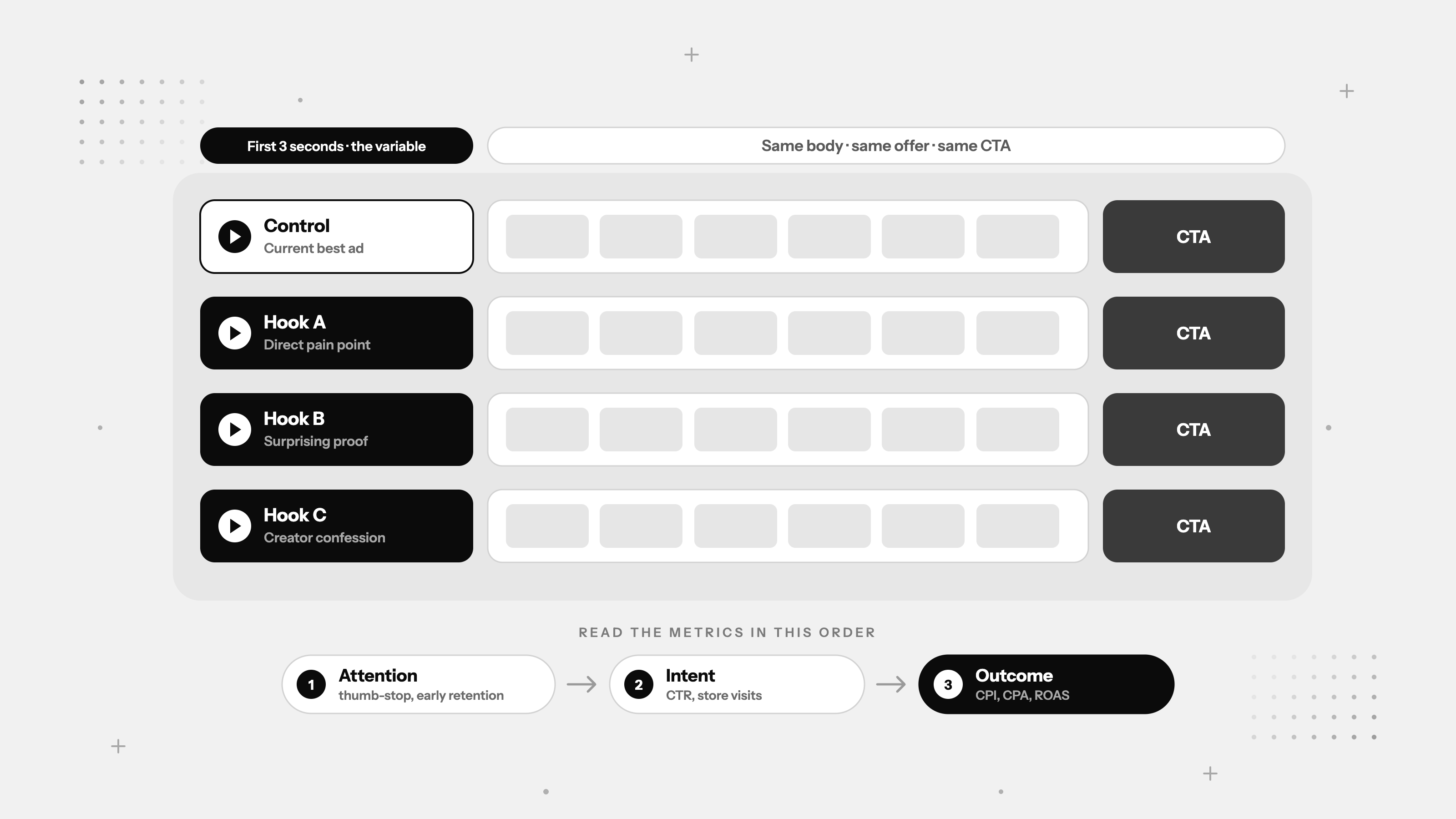
A useful creative pipeline tests different variables on purpose. Hooks should earn attention in the first seconds. Proof should make the claim believable. The offer, visual pacing, creator delivery, gameplay moment, and call to action can all affect conversion. Stop testing ads as whole, indivisible objects. Start testing hooks, messages, proof points, and formats that reveal why an ad works.
For mobile games, that may mean testing distinct gameplay tensions rather than minor edits to the same capture. For wellness apps, it may mean separating outcomes like better sleep, stress relief, and habit consistency rather than cramming every benefit into one video. The insight should guide the next round of production, not disappear into a reporting slide.
Let Marginal Performance Make the Next Decision
Average performance is useful for reporting. Marginal performance is more useful for allocation.
If a campaign spent $20,000 last month at a $40 CPA, that does not mean the next $20,000 will also acquire customers at $40. The key question is what happened as spend increased. Did CPA hold? Did it rise gradually? Did it spike after a certain threshold? Those answers tell you whether the campaign is ready for more budget or needs fresh creative before another scale attempt.
Review performance by spend tier where possible. Compare the efficiency at lower daily spend with efficiency after meaningful increases. Account for conversion lag, especially for products with trials, subscriptions, or longer consideration cycles. Cutting a campaign before later conversions mature can cause the team to favor fast, low-quality outcomes.
Platform attribution also deserves skepticism. Meta, TikTok, Google, and CTV can all report success within their own measurement windows. That does not mean each platform independently drove every credited conversion. Use platform data for in-platform optimization, then pressure-test allocation decisions against blended CAC, revenue, retention, and incrementality where the data allows.
You do not need perfect measurement to make better decisions. You need a consistent measurement hierarchy and the discipline not to confuse attributed results with the entire business result.
Avoid the Two Budget Traps
The first trap is overconcentration. A channel can be your strongest acquisition engine and still become a risk when it receives nearly all spend. One algorithm change, one creative drought, or one audience saturation issue can turn a dependable program into a revenue problem. Diversification is not about funding every channel. It is about building credible alternatives before you need them.
The second trap is fragmentation. Spreading spend across too many platforms, campaigns, and audience segments creates thin data and slow learning. A $100,000 monthly budget cannot operate like a $2 million monthly budget. Focus beats coverage when spend is limited.
The answer is not a fixed number of channels. It is concentration with an exit plan. Put meaningful spend behind what works, while maintaining enough exploration to develop the next source of efficient volume. If TikTok is promising but unproven, fund it at a level that can produce a decision, not a level that merely produces noise.
Reallocate on a Cadence, Not on Emotion
Daily dashboard checking creates reactive budget decisions. One bad day becomes a panic. One good day becomes an unjustified scale push. Platforms fluctuate, and conversion data matures at different speeds.
Set a review rhythm that matches the buying cycle. Fast-moving paid social programs may need daily monitoring but twice-weekly allocation decisions. Subscription products with longer conversion windows may need longer decision periods. During major promotions, launches, or seasonal spikes, shorten the feedback loop without abandoning your guardrails.
Make reallocation rules explicit. Increase spend when marginal efficiency remains within target and creative supply is ready. Hold spend when performance is acceptable but signal is incomplete. Reduce spend when the decline persists after accounting for attribution lag, audience saturation, and creative refreshes. The point is not to eliminate judgment. It is to stop letting the loudest dashboard movement make the decision.
Give Every Dollar a Clear Job
The best budget plans are not static spreadsheets. They are operating systems. They connect financial targets, campaign performance, creative output, and the next set of decisions.
When a channel underperforms, do not automatically take its money away. First identify the failure point. Is demand weak? Is the audience exhausted? Is the offer uncompetitive? Did the creative fail to communicate the value quickly enough? Sometimes a budget cut is correct. Sometimes the smarter move is to fund a sharper creative test before declaring the channel dead.
Your next allocation meeting should end with more than percentages. It should identify which growth bet deserves room to scale, which creative questions need answers, and what evidence would change the plan. That is how paid media becomes less of a spending exercise and more of a compounding acquisition system.