Creative Strategy
Creative Strategy
Mobile App Growth Strategy That Scales Revenue
Build a mobile app growth strategy that connects creative, creators, paid media, and measurement to cut acquisition costs and scale revenue reliably.

Most app teams do not have a media buying problem. They have a learning problem. They spend more to push the same tired concept across Meta, TikTok, Google, and app networks, then call rising CPAs a targeting issue. A real mobile app growth strategy creates a faster system for finding demand, proving which messages move users to act, and scaling only when the economics hold.
That changes the role of creative. It is not a final deliverable after the strategy is done. It is the strategy made visible, measurable, and ready to run.
Growth starts with the economic event that matters
An install is not always growth. For a mobile game, the meaningful event may be a completed tutorial, a retained player, an in-app purchase, or an ad monetization threshold. For a subscription app, it may be a trial start, trial-to-paid conversion, a second billing cycle, or a predicted lifetime value signal. For a health and wellness app, the first completed session may be the leading indicator that separates curiosity from intent.
Start by defining the event your acquisition program is actually buying. Then work backward through the funnel: what is the maximum allowable cost for that event, what early actions correlate with it, and what volume is needed before you trust the read?
This sounds basic. It is also where many teams lose control. If a campaign is optimized to cheap installs while finance is measuring payback from paid subscribers, the channel can look efficient and still destroy margin. The dashboard may be accurate. The optimization goal is wrong.
Your growth model should connect media cost, conversion rate, retention, monetization, and creative performance in one view. That does not mean waiting for perfect attribution. It means knowing which leading indicators are useful enough to make better decisions this week, while longer-term cohort data validates those decisions over time.
Build a mobile app growth strategy around learning velocity
The strongest teams do not ask, “What ad should we make?” They ask, “What uncertainty is costing us the most growth right now?” That uncertainty might be whether a new audience understands the core benefit, whether a gameplay feature has acquisition potential, or whether a trial offer attracts users who will actually convert.
Each creative test should answer one focused question. Broad, unfocused testing produces broad, unfocused conclusions.
If your current ads all lead with product features, test a pain-first hook against an outcome-first hook. If your game ads show polished gameplay but weak click-through rates, test a more immediate challenge, failure moment, or reward reveal in the first two seconds. If your subscription app gets strong trial volume but poor trial quality, test messaging that sets clearer expectations before the install.
The variable matters more than the volume of files. Ten new edits built around the same opening, claim, pacing, and audience assumption are not ten tests. They are one idea with ten exports.
A productive testing roadmap usually separates three layers:
- Concept: The central promise, tension, or audience insight.
- Hook: The first visual and line that earns attention.
- Execution: The creator, script, edit pace, captions, proof points, sound, and call to action.
- Format: The platform-native container, such as UGC, gameplay capture, motion design, a playable ad, or Connected TV.
Test concepts first when you need a new growth angle. Test hooks when the concept is working but performance is fading. Test executions when you have a proven message and need more scale across placements, audiences, or platforms.
Stop testing ads. Start testing hooks, claims, objections, and moments of proof.
Make creative do the targeting work
Platform targeting has become broader, more automated, and less forgiving of vague messaging. That is not a reason to abandon audience strategy. It is a reason to express your audience strategy inside the ad.
A sleep app should not speak to “people interested in wellness.” It should speak to the person staring at the ceiling at 2 a.m., frustrated that another day will begin exhausted. A kids gaming platform should show the parent what is safe, engaging, and worth the screen time before asking for the download. A strategy game should make the player feel the tactical decision, not just watch a montage of wins.
Specificity creates self-selection. The wrong users scroll past. The right users recognize themselves.
This is why generic benefit statements underperform. “Feel better” and “play smarter” are technically positive, but they do not create a reason to stop scrolling. Strong performance creative opens with a recognizable problem, an unexpected contrast, a credible result, or a piece of product proof that viewers can process instantly.
For app advertisers, proof can take many forms: real in-app flows, before-and-after behavior, an expert explanation, a creator’s honest reaction, user outcomes, review language, feature demonstrations, or gameplay that makes the value proposition obvious. The right proof depends on the category. Overproduced ads can damage trust in wellness, finance, or parenting. Raw creator footage can feel out of place for a premium game launch. Platform-native does not mean low effort. It means the execution matches how the audience evaluates that kind of message.
Treat creators as a performance channel, not a content request
Influencer and creator programs often fail because they are managed as brand awareness projects with performance expectations attached at the end. If creators are expected to help acquire users, the brief, usage rights, delivery process, and reporting model need to support paid distribution from day one.
Choose creators for audience fit and on-camera credibility, not follower count alone. A creator who can explain a niche productivity workflow or demonstrate real gameplay tension can be more valuable than a broad lifestyle account with a large but passive audience.
Give creators a clear job. One might lead with a personal problem. Another can demonstrate the product. A third can challenge skepticism or compare the app with the old way of doing something. Let the creator’s voice stay intact, but do not confuse freedom with a lack of direction. The best creator briefs define the audience tension, required product truth, prohibited claims, and multiple hook territories to explore.
Then turn the best creator assets into a paid creative system. Cut variations, test new openings, add direct-response calls to action, and use the performance data to inform the next round of creator sourcing. Organic engagement is useful context. Cost per qualified action, trial quality, purchase rate, and incremental scale are the commercial read.
Match measurement to the decision
Attribution is rarely clean enough to answer every question with certainty. Privacy changes, modeled conversions, delayed revenue, and cross-device behavior all create gaps. The response is not to wait for a perfect source of truth. It is to use the right measurement method for the decision in front of you.
For rapid creative decisions, platform-level signals such as thumb-stop rate, click-through rate, cost per install, and early in-app events can identify whether an idea deserves more spend. For budget allocation, compare blended acquisition costs, cohort quality, marginal CPA, and revenue contribution across channels. For major investment decisions, use holdouts, geo tests, lift studies, or carefully designed spend experiments when the volume supports them.
Be careful with averages. A campaign can deliver an acceptable blended CPA while one creative angle is bringing in high-value users and another is filling the funnel with low-intent volume. Segment by creative concept, platform, audience, placement, and cohort behavior before declaring a winner.
The goal is not more reporting. It is fewer bad decisions made with incomplete reporting.
Scale a portfolio, not one winning ad
Every winning ad has an expiration date. Frequency rises, competitors copy the angle, comments change the context, and the audience simply gets used to seeing it. Teams that rely on a single control creative eventually pay the fatigue tax in public.
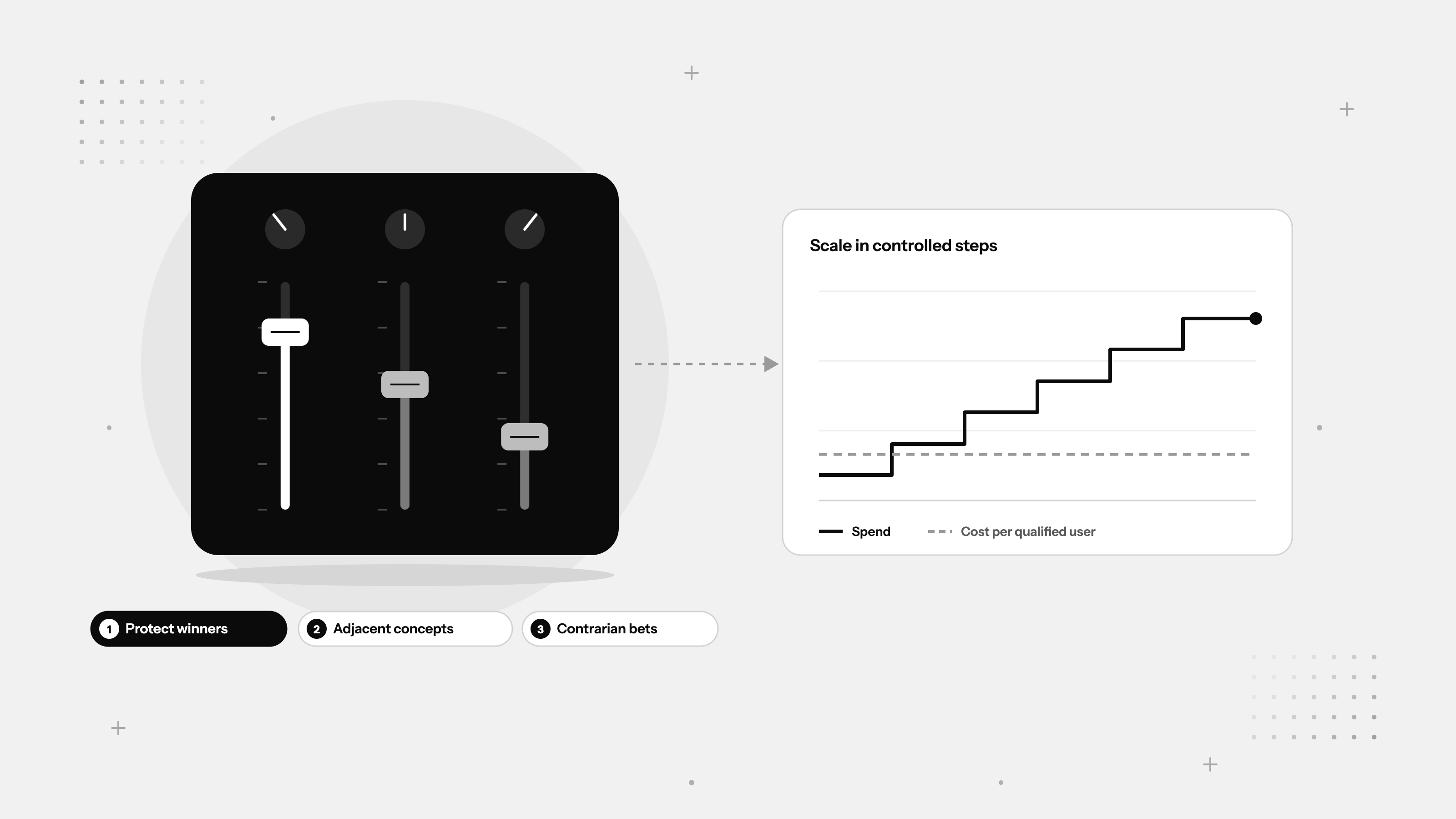
Build scale through a portfolio of distinct concepts. Keep proven controls live, but continue feeding new angles into the account. When a concept works, do not immediately produce twenty near-identical versions. First identify why it worked. Was it the audience pain point, the offer, the visual demonstration, the creator’s credibility, or the opening line? Then create adjacent tests that preserve the underlying insight while changing the surface execution.
For mobile games, that may mean testing different moments of tension: the impossible level, the satisfying upgrade, the competitive win, or the strategic choice. For subscription apps, it may mean shifting from aspirational outcomes to a specific daily use case, expert proof, or a sharper objection-handling message.
More spend should follow evidence, not enthusiasm. Raise budgets gradually enough to see whether efficiency holds as reach expands. A creative that performs at $500 per day may not survive at $10,000 per day because it has exhausted its natural audience. That is not a failed ad. It is a signal that the concept needs broader variants, another platform, or a different role in the funnel.
Run growth as an operating cadence
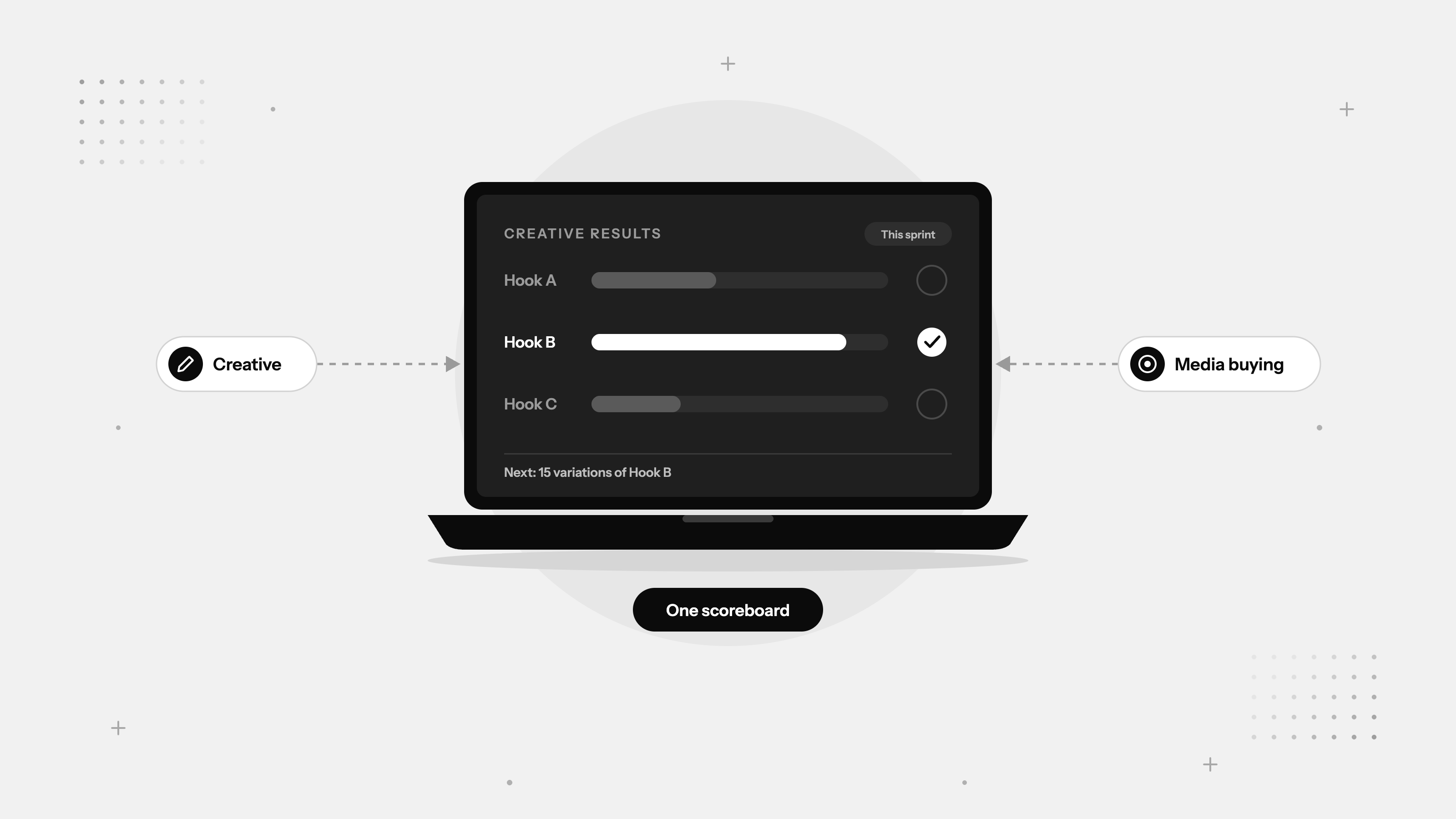
The strategy only works when it becomes a weekly operating rhythm. Review media performance and creative performance together. Decide which concepts need more variants, which messages need to be retired, which creator insights should shape the next brief, and which funnel events need investigation.
Keep the conversation tied to actions. “CTR fell” is an observation. “The pain-first hook has fatigued among our highest-value audience, so we are launching three proof-led openings against the same landing experience” is a plan.
The teams that scale efficiently are not the ones that find a magic ad. They are the ones that turn every campaign result into the next better test. Build that loop, protect the quality of the signal, and growth becomes less dependent on luck.