Creative Strategy
Creative Strategy
What a Performance Creative Agency Actually Does
A performance creative agency connects strategy, production, creators, and media buying to lower CPA, improve ROAS, and scale proven ad concepts faster.

A rising CPA is rarely just a media-buying problem. Often, the audience has seen the same promise too many times, the opening hook is weak, or the ad was built for a brand presentation instead of a live auction. A performance creative agency exists to fix that gap: connecting what gets made to what actually drives installs, trials, purchases, and revenue.
That distinction matters when paid acquisition is no longer cheap enough to hide mediocre creative. Growth teams need a steady supply of platform-native concepts, fast feedback loops, and a partner that can translate performance data into the next round of ads. Not a quarterly campaign deck. Not a folder full of beautiful assets with no media plan. Creative built to run.
What a Performance Creative Agency Actually Does
A traditional creative agency is often organized around campaigns, brand guidelines, and production milestones. A performance creative agency is organized around outcomes. Its work begins with a commercial question: What is preventing this account from scaling efficiently right now?
The answer may be a weak first three seconds on TikTok, an offer that does not land with a high-intent Meta audience, a lack of credible creator-led proof, or a landing-page message that does not match the ad. The job is to identify the friction, develop testable creative hypotheses, produce the assets, deploy them through paid media, and use results to decide what to make next.
This is not creative for creative's sake. It is a production and optimization system tied to the metrics your business already cares about: cost per install, cost per trial, customer acquisition cost, return on ad spend, retention, and payback period.
Strategy starts with the business model
Performance creative should reflect how a company grows. A mobile game may need gameplay-led hooks, progression moments, and playable formats that give users a taste of the core loop. A health app may need to overcome skepticism with founder stories, customer proof, or a clearer explanation of its subscription value. A consumer product may need a creator to demonstrate the problem, product, and payoff in less than 20 seconds.
The same visual style will not solve all three problems. Neither will generic "best practices." A strong partner researches the category, reviews existing winners and losers, studies audience comments and competitor positioning, and maps creative ideas to funnel stages. The result should be a clear testing plan, not a vague request for more content.
Production is designed as a system, not a one-off deliverable
A winning idea is valuable. A winning idea with 15 meaningful variations is usually more valuable.
That does not mean changing button colors or swapping captions and calling it experimentation. It means isolating the variables that influence response: the hook, protagonist, pain point, proof mechanism, offer, pacing, voiceover, visual treatment, and call to action. Each variation should tell the team something useful.
For example, if a creator video earns strong thumb-stop rate but weak conversions, the issue may be message-to-offer alignment rather than the creator. If one gameplay concept produces efficient installs but poor retention, the ad may be overselling an experience the product cannot deliver. Performance creative work requires that level of diagnosis.
Why Creative and Media Buying Need to Work Together
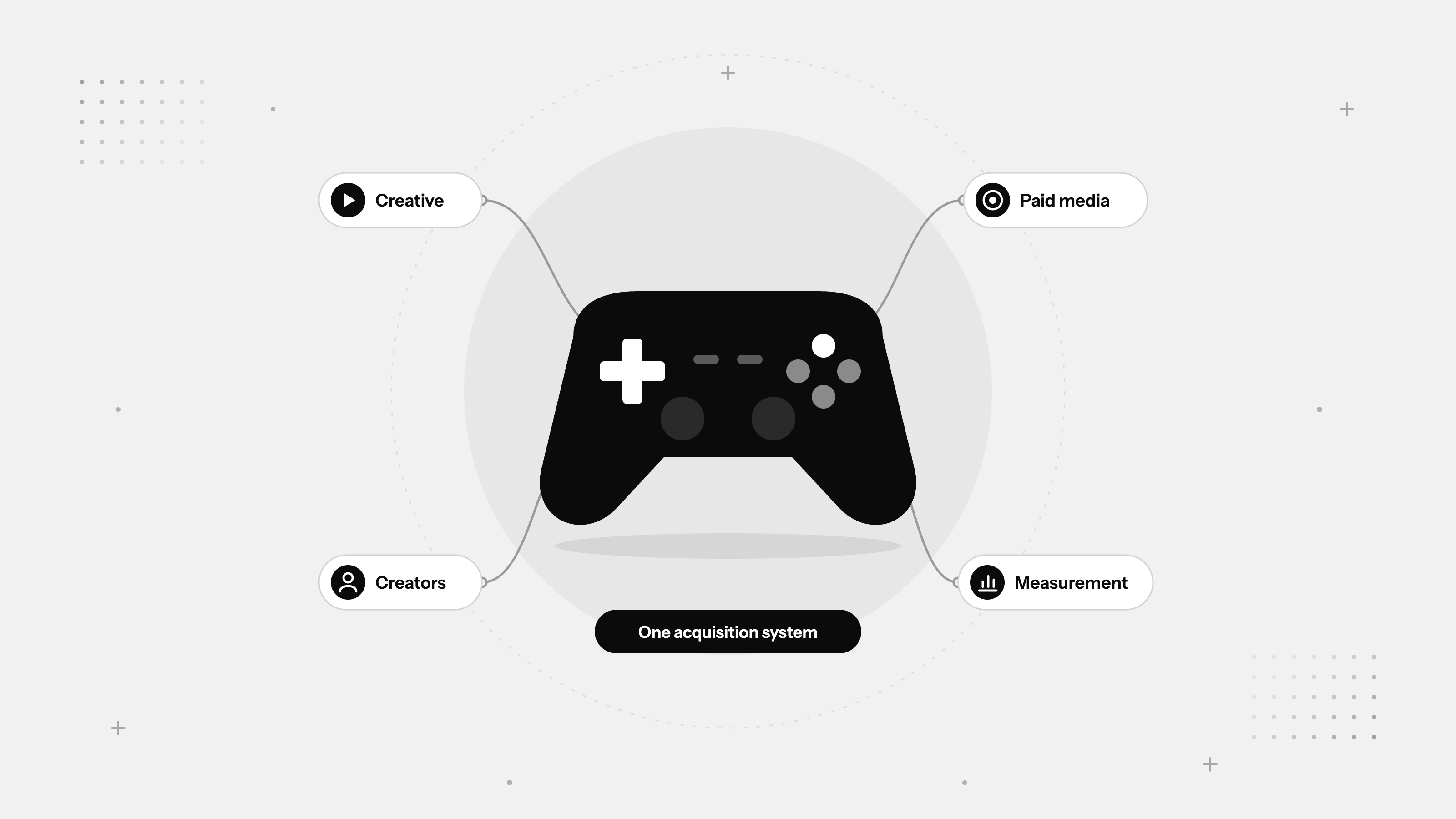
The most expensive setup is not an agency fee. It is a fragmented workflow where creative, influencer marketing, and paid media operate with different definitions of success.
When production is separated from media, the creative team may optimize for polish while buyers need more hooks, formats, and faster iterations. When creators are sourced without a performance brief, brands receive content that looks authentic but does not communicate the product or give media teams usable testing angles. When buyers only report results after a campaign ends, creative learns too late.
A better operating model puts these functions around the same scoreboard. Media results inform the creative roadmap. Creator selection reflects the audience and platform. Production briefs include placement requirements from the beginning. The team can then move from signal to new assets while the opportunity is still active.
This matters across channels, but the execution changes by platform. Meta often rewards clear benefit statements, social proof, and strong conversion architecture. TikTok needs native pacing, credible personalities, and an opening that earns attention immediately. Google may require a tighter connection between search intent, visual proof, and the destination experience. Connected TV demands a different level of production quality while still making the value proposition instantly legible.
One master video cut rarely performs equally well everywhere. Platform-native adaptation is not extra polish. It is part of the performance strategy.
What to Expect From a Good Performance Creative Agency
The right partner should make your internal team faster and more informed, not simply add another approval layer. That starts with a disciplined monthly rhythm: review performance, identify the highest-value opportunities, prioritize concepts, produce assets, launch tests, and turn learnings into the next sprint.
You should expect clear answers to a few practical questions. What is being tested? Why is it being tested now? Which metric will determine whether it is working? What will the team do if it wins, loses, or produces mixed signals?
The answer will vary by account maturity. A newer advertiser may need broad exploration across audiences, messages, and formats before narrowing down. A brand spending heavily may already know its best audience and need a more aggressive creative refresh engine to prevent fatigue. In both cases, volume matters only when it is connected to a point of view.
A capable agency should also be comfortable working across formats. UGC may be the right starting point for a subscription app that needs trust. AI-generated or AI-animated assets can help explore visual territories quickly. Motion design can clarify a complex product flow. HTML5 playable ads can turn mobile gameplay into a direct acquisition experience. High-quality CTV spots can build demand at the top of the funnel while paid social converts it.
No single format is inherently superior. The format has to match the product, audience, channel, and job the ad needs to do.
Questions to Ask Before You Hire
Do not evaluate a partner solely on their showreel. Ask how they define a creative test, how frequently they review results, and whether their production team sees media performance directly. Ask who owns creator sourcing and usage rights, how quickly they can react when a concept starts working, and whether they can run the campaigns or coordinate effectively with your in-house buyers.
It is also worth asking how they handle failure. Most tested concepts will not become scalable winners. That is normal. The concern is an agency that cannot explain what a losing result taught them or responds by producing more of the same.
Look for specificity. "We make high-converting ads" is easy to say. A useful answer sounds more like: "This angle is losing attention in the first second, so we are replacing the setup with a product-first hook and testing proof earlier in the sequence." That is how an embedded growth team thinks.
Stop Ordering Ads and Start Building a Learning Engine
The best performance creative relationship is not transactional. It is a working system that gets sharper as it collects more data. Your team brings product knowledge, business priorities, and customer context. The agency brings pattern recognition across platforms, production capability, creator access, and the operating discipline to turn learnings into new inventory.
Scrolling Media works from that premise: creative should be measured by what it does in market, not how it looks in a presentation. The goal is not to produce more ads for the sake of output. It is to keep finding stronger hooks, clearer messages, and more efficient paths to growth.
If your media spend is active but results are flattening, do not start by asking for a new campaign. Start by asking what your latest creative results are trying to tell you. The next scalable idea is usually hiding inside that answer.