Creative Strategy
Creative Strategy
Acquisition Funnel Guide for Paid Growth Teams
This acquisition funnel guide shows paid growth teams how to align creative, media, and measurement to improve conversion efficiency through the funnel.

A rising CPA is rarely just a bidding problem. More often, it is a signal that the ad, audience, landing experience, or post-click product journey has stopped working together. This acquisition funnel guide is built for growth teams that need to find that break quickly, fix it with evidence, and turn paid spend into more installs, trials, purchases, and revenue.
The funnel is not a media plan with awareness at the top and conversion at the bottom. It is a connected operating system. Creative creates demand. Media finds and prices demand. The destination converts it. Measurement tells you which part deserves more investment. If one layer lags, efficiency drops everywhere.
What an acquisition funnel actually measures
An acquisition funnel tracks the path from first exposure to a valuable business action. For a mobile game, that may be an ad impression, install, tutorial completion, first purchase, and long-term payer value. For a subscription app, it could be impression, click, install, account creation, trial start, paid conversion, and retention.
The exact events change by business model. The operating principle does not: optimize toward the deepest event you can measure reliably and afford to wait for. Teams that optimize only for cheap clicks can manufacture activity without creating customers. Teams that optimize only for a rare downstream event can starve platforms of the signal volume required to learn.
That is why funnel design is a trade-off, not a fixed template. A mature subscription product with stable trial-to-paid data may optimize directly to a paid subscription. A new app with low purchase volume may start with a qualified onboarding event, then move deeper as volume grows. The right conversion event is the one that balances quality, volume, and speed.
The acquisition funnel guide: build from the outcome backward
Start with the outcome your business can profitably buy. Do not begin with a channel, a creator roster, or a list of ad concepts. Begin with the unit economics.
Define the acceptable cost per acquisition based on contribution margin, expected retention, and payback window. If a trial is worth $40 after accounting for trial-to-paid conversion and early churn, a $60 trial CPA is not a creative win because click-through rate looks healthy. It is an expensive way to prove that your reporting dashboard can count.
Then map the events that lead to that outcome. For each event, capture conversion rate, cost, volume, and time lag. A simple funnel table can reveal where the real constraint sits. Strong click-through rate with weak landing-page conversion points to message mismatch, friction, or an unconvincing offer. Strong install volume with poor activation points to a promise the product does not fulfill fast enough. Good trial starts and poor paid conversion may point to onboarding, pricing, or low-quality acquisition sources.
This is where many teams lose weeks. They see an expensive result and immediately ask for more ads. More ads can help, but only if the current creative is the bottleneck. Diagnose before producing.
Use one primary metric per campaign
Campaigns need a clear job. Prospecting may be accountable to cost per activated user. Retargeting may be accountable to cost per purchase or incremental revenue. A connected TV campaign may support reach and branded search lift, but it still needs a defined measurement plan before budget expands.
Trying to make every campaign maximize awareness, clicks, purchases, and ROAS at once creates muddy decisions. Give each campaign a primary success metric and a small set of guardrails. For example, optimize a prospecting campaign to trial starts while monitoring trial-to-paid rate and early retention. That keeps the platform learning toward volume without rewarding low-intent users.
Creative is the funnel's first conversion event
An ad does not merely communicate a message. It pre-qualifies the user. The hook decides who stops. The proof decides who believes. The call to action decides who moves.
That means creative should be built around funnel questions, not broad requests for “fresh assets.” What objection is suppressing conversion? What audience tension can the first two seconds make visible? What product proof will reduce uncertainty before the click?
For a wellness app, a creator explaining a specific habit problem may outperform polished lifestyle footage because it creates immediate relevance. For a mobile game, a playable ad can qualify users through real gameplay mechanics before an install. For a consumer subscription product, a direct comparison, testimonial, or product demonstration may outperform a brand-forward spot when the buyer needs proof before committing.
The best format depends on the channel and the buyer's awareness. TikTok and Reels often reward native pacing, human faces, clear tension, and fast product context. Meta can scale multiple angles across broad audiences when the creative gives its delivery system enough distinct signals. Google captures existing intent, so creative and landing pages must match the searcher's exact problem. Connected TV can build memory and reach at scale, but it usually needs a strong response path and a measurement strategy beyond last-click attribution.
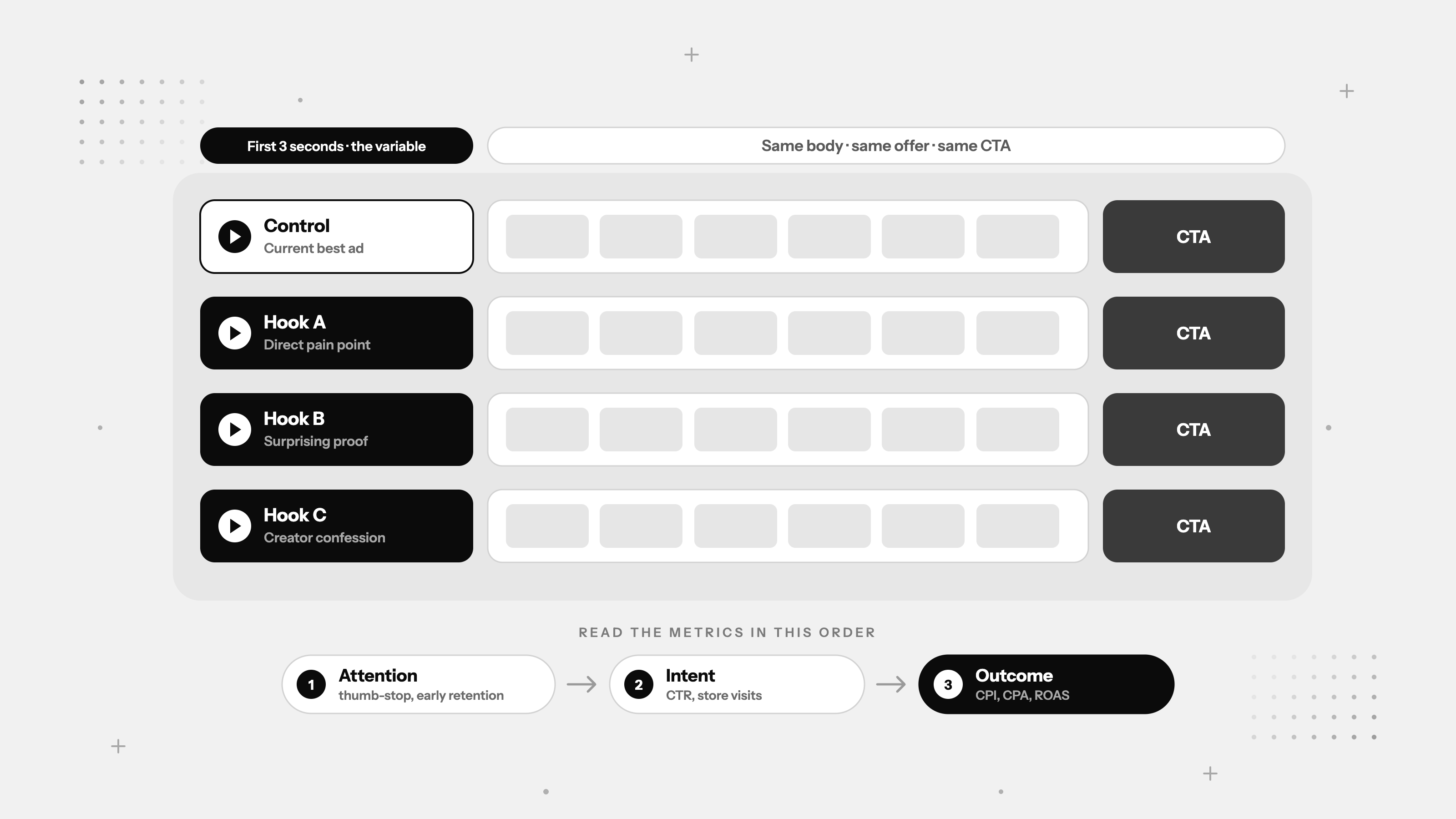
Stop testing ads as isolated files. Start testing hooks, claims, proof types, visual systems, offers, and calls to action. A new edit of the same weak premise is not a meaningful test.
Match the post-click experience to the promise
Every conversion path has a handoff. The ad makes a promise, and the landing page, app store listing, or product onboarding must keep it.
If an ad promises “personalized meal plans in two minutes,” the first screen after click should not lead with a generic mission statement. It should make the personalization process obvious. If a game ad showcases a puzzle mechanic, the store page and first gameplay moments should confirm that experience. Message mismatch increases bounce rates, wastes paid traffic, and teaches platforms to find cheaper but less qualified users.
Mobile teams should treat app store creative as part of acquisition, not a separate brand asset. Screenshots, preview videos, ratings context, and value propositions can change install conversion materially. Web teams should examine page speed, form friction, checkout steps, mobile readability, and offer clarity before concluding that traffic quality is the issue.
Measure the right signal, not the easiest signal
Last-click reporting is useful, but it is not the whole truth. It tends to over-credit channels nearest to conversion and under-credit the creative and media that created demand earlier. That does not mean abandon platform reporting or attribution tools. It means use multiple views and understand what each can and cannot answer.
Platform data helps make fast delivery decisions. Product analytics reveals activation and retention quality. Blended metrics show whether total acquisition is becoming more or less efficient. Incrementality tests, holdouts, geo tests, and lift studies help answer the harder question: would these customers have converted without this spend?
You do not need a perfect measurement system before acting. You need a measurement system honest enough to prevent false confidence. Track cohorts by source and creative angle. Compare early quality signals against later revenue. Watch whether higher spend changes marginal CPA, not just average CPA. When a winner scales, verify that it still produces valuable users after the first burst of cheap inventory disappears.
Find the bottleneck before increasing budget
When performance slips, use the funnel to isolate the issue. Four questions usually get teams to the right work faster:
- Has delivery changed? Check CPM, reach, frequency, auction competition, and audience saturation.
- Has the ad changed in effect? Check thumb-stop rate, hold rate, click-through rate, and creative-level conversion.
- Has the destination changed? Check page or store conversion, load speed, tracking, offer visibility, and onboarding completion.
- Has user quality changed? Check activation, retention, refund behavior, trial-to-paid rate, and revenue by cohort.
The answers matter because the fixes are different. High frequency and falling click-through rate call for new creative territory, not a landing-page redesign. A sudden decline in checkout conversion may be a site or payment issue, not a media issue. Cheap installs with weak retention require tighter qualification in both creative and optimization events.
Build a testing cadence that can compound
One-off creative sprints create temporary relief. A repeatable testing system creates a performance advantage. Set a monthly strategy cadence around market shifts, audience feedback, platform data, and prior test results. Then produce enough distinct concepts to learn, not just enough variants to fill placements.
Each concept should have a documented hypothesis. For example: showing the product result before the product explanation will increase qualified trial starts among cold audiences. Or: a gameplay failure hook will reduce CPI without hurting day-seven retention. That hypothesis determines what changes, what stays constant, and what result would count as a meaningful win.
Keep winners in market long enough to validate them, but do not protect them out of habit. Creative fatigue is not only frequency. It is also audience familiarity, competitor imitation, seasonal relevance, and a platform's changing preference for formats. Maintain a pipeline of new angles while scaling proven ones.
A strong acquisition funnel does not make every campaign predictable. It makes the next decision clearer. When creative, media, product experience, and measurement operate as one growth system, your team stops reacting to CPA spikes and starts building a machine that earns the right to spend more.