Creative Strategy
Creative Strategy
Agency vs Inhouse Media Buying: What Scales?
Agency vs inhouse media buying affects speed, creative testing, and cost. See which model helps your performance budget scale with control without waste.

A stalled acquisition account rarely has one obvious cause. CPA creeps up, spend stops scaling, and the team starts debating whether the answer is another internal hire or an outside partner. The agency vs inhouse media buying decision matters because it determines how quickly you can identify what is failing, ship a better creative angle, and put budget behind what works.
For growth teams buying on Meta, TikTok, Google, AppLovin, or streaming channels, media buying is not simply campaign maintenance. It is a live operating system connecting audience signals, creative volume, offer strategy, landing-page performance, and budget allocation. The right model is the one that improves that system - not the one with the most impressive org chart.
Agency vs Inhouse Media Buying: The Real Trade-Off
The common framing is control versus expertise. That is too simplistic. A strong in-house team can be highly specialized. A strong agency can feel like an extension of your company. The more useful comparison is operational: Which team can turn performance data into new, platform-native ads and smarter spend decisions with the least delay?
In-house media buying gives you direct access to the people managing the account. Your buyer lives with the product roadmap, joins internal planning, understands changing inventory or subscription economics, and can coordinate quickly with product, analytics, and lifecycle teams. For brands with enough scale, that proximity is valuable.
But proximity does not automatically create performance. One buyer, even a talented one, can become the bottleneck when they are managing reporting, pacing, campaign builds, stakeholder requests, creative feedback, and troubleshooting. The result is often familiar: the account is technically maintained, but creative testing slows down. And when creative volume slows, learning slows with it.
An agency brings a different advantage: pattern recognition across accounts, channels, formats, and categories. A team that sees dozens of hooks, creator structures, bidding approaches, and fatigue cycles can diagnose problems faster than a team looking at one brand in isolation. The best agency partners also bring the specialists most internal teams cannot justify hiring full time: paid social operators, search buyers, creative strategists, editors, motion designers, creator managers, and data analysts.
The downside is real. A poorly run agency can become a reporting layer between your business and your ad account. It may use generic creative frameworks, wait too long for approvals, or optimize toward easy platform metrics rather than actual revenue quality. That is not an argument for bringing everything inside. It is an argument for demanding a partner with direct access, clear accountability, and production tied to acquisition outcomes.
When an In-House Team Has the Edge
In-house can be the right answer when your paid media program is mature and stable enough to support it. If your spend is consistently high, your product has a deep funnel, and your company can recruit and retain specialists, an internal team can build extraordinary institutional knowledge.
This is especially true when media decisions depend on information that changes daily. A gaming studio with live events, an app with frequent paywall tests, or a subscription business managing inventory constraints may need buyers embedded in the business. They can react immediately when a new offer launches, a retention cohort shifts, or product economics change.
In-house also works well when there is a real creative engine beside the buyer. That qualifier matters. Hiring a media buyer without dedicated creative strategy and production is not building a growth function. It is hiring someone to operate campaigns with a limited supply of new inputs.
Creative is the lever. The buyer can identify that an ad is fatigued or that a prospecting audience needs a new message. They cannot manufacture ten credible new concepts, recruit the right creators, edit variations, produce gameplay captures, or build a playable ad while keeping the account moving. If your internal model does not solve for production capacity, it will eventually hit a testing ceiling.
When an Agency Produces Better Economics
Agencies make the strongest case when speed, breadth, and creative throughput are the constraints. That describes many growth-stage brands. They have meaningful spend, ambitious targets, and a lean internal team, but they do not need five separate full-time specialists before they can test an idea.
A performance-focused agency should give you a connected operating model. Strategy informs concepts. Concepts become ads tailored to the channel. Ads launch with a clear testing plan. Media results feed the next creative brief. The loop keeps moving until the account finds scalable winners - then it moves again before fatigue erodes efficiency.
This matters because platform-native creative is not interchangeable. A polished 30-second CTV spot has different job requirements than a TikTok creator ad. A Meta acquisition video may need a direct first-second hook, proof early in the narrative, and a clear offer. A mobile game may need gameplay that makes the core loop legible before the viewer scrolls away. Google can require a different mix of message, intent, and landing-page alignment.
An agency with media and production under one roof can make those distinctions practical. Instead of asking a buyer to write a vague request for a separate creative vendor, the team can review performance data and commission the next set of ads around actual market feedback. That is where the economics improve: fewer disconnected handoffs, more informed iterations, and less money spent forcing a tired concept to scale.
The Cost Question Is Bigger Than Fees
Comparing an agency retainer to an employee salary is one of the fastest ways to make the wrong decision. The true in-house cost includes salary, benefits, management time, recruiting risk, software, analytics support, and the surrounding creative resources needed for that buyer to succeed.
A senior buyer may cost less than an agency on paper. But if that person needs a designer, video editor, strategist, creator network, and additional channel specialists to match the agency’s output, the calculation changes quickly. It changes again if the company loses months replacing a key hire.
Agency cost should also be evaluated beyond management fees. Ask what is included in the working model. Are strategy, asset development, creator coordination, campaign execution, and reporting connected? Is there a stated cadence for testing? Does the agency have the capacity to make fresh ads after the first launch? Are they optimizing to cost per install, trial, purchase, ROAS, or the business metric that actually matters?
Cheap management is expensive when it leaves performance opportunities on the table. The right question is not, “What does this team cost?” It is, “What does this team make possible at our current budget?”
Build Around the Bottleneck, Not the Org Chart
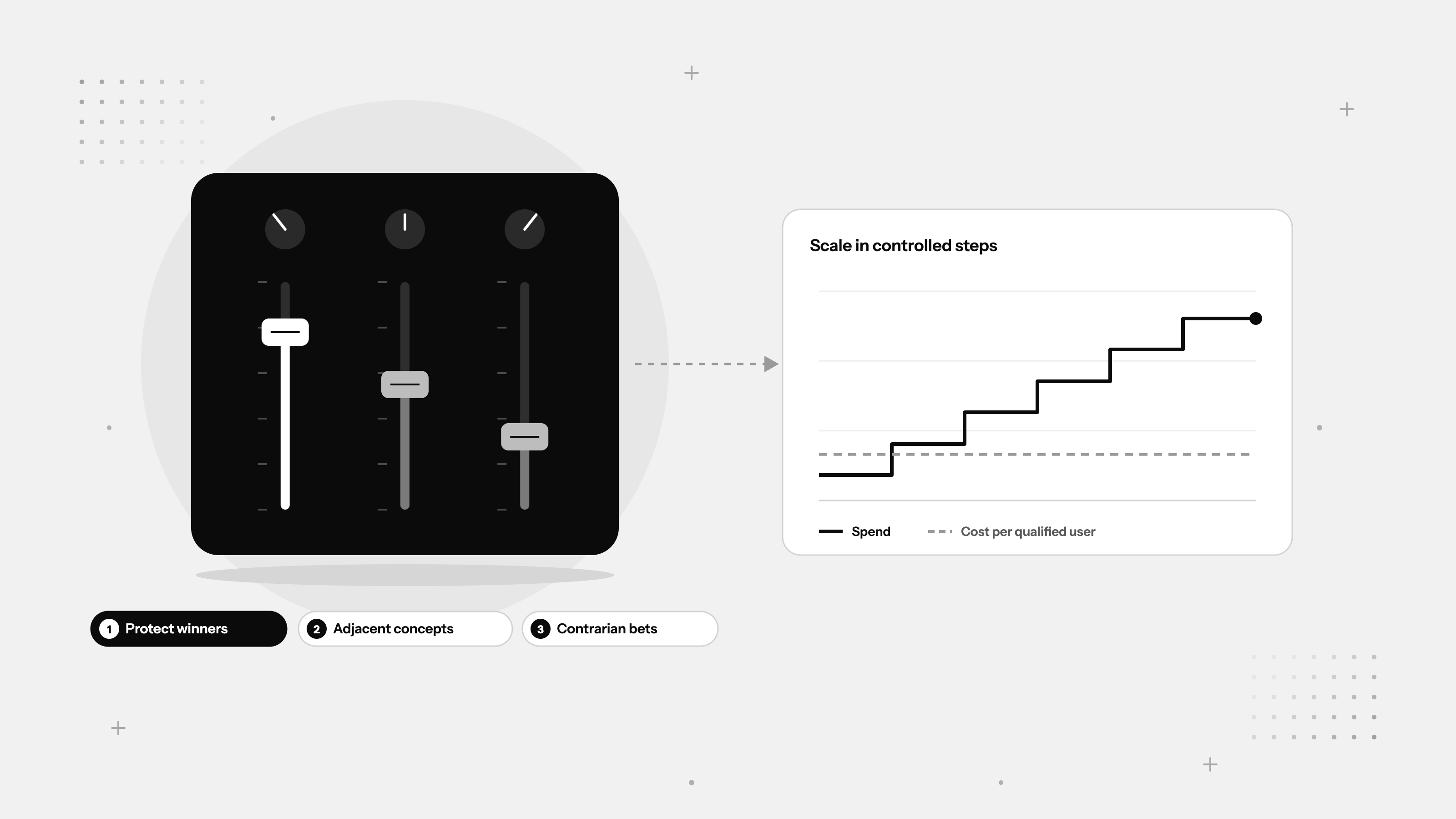
Many advertisers do not need to choose a pure model. A hybrid structure is often the best answer. Keep product knowledge, analytics ownership, brand direction, and business priorities in-house. Use an external growth partner to add channel depth, creative production capacity, creator access, and faster testing.
This structure works particularly well when an internal paid social lead needs more execution power, not replacement. The internal team sets the commercial priorities and owns the customer truth. The agency brings a dedicated testing machine that can turn those priorities into live ads across channels.
For example, a wellness app might have strong internal insight into why subscribers retain but lack a reliable process for translating those insights into weekly creator ads. A mobile game studio may understand its gameplay and monetization perfectly, yet need playable-ad production and a broader UA testing bench. A consumer subscription brand may have a capable growth leader but no in-house editor who can produce high-volume Meta and TikTok variants quickly enough.
These are not failures of internal teams. They are capacity problems. Solve the bottleneck instead of rebuilding the whole department.
Questions to Ask Before You Decide
Start with the pace of your learning. How many meaningful creative concepts can your current setup test each month, not just how many minor edits can it produce? How quickly can a weak result become a new hypothesis and a new asset? If the answer is measured in weeks, the issue is probably not media buying alone.
Then look at channel complexity. A brand spending heavily on one platform with a stable offer may be able to build internally sooner. A brand running Meta, TikTok, Google, influencer partnerships, AppLovin, and CTV needs broader capabilities and tighter coordination. Fragmentation becomes costly fast.
Finally, define ownership before work begins. Whether you choose an internal team, an agency, or a hybrid model, your company should own the ad accounts, performance data, creative learnings, and decision rights. The operating cadence should be visible: what is being tested, why it is being tested, what won, what lost, and what happens next.
The best media buying model is the one that keeps your creative learning loop faster than your competitors'. If your team can do that internally, invest in it. If it cannot, bring in a partner built to turn data into ads that are delivered ready to run. Stop treating media buying as account upkeep. Treat it as the engine that turns better creative decisions into scalable growth.